In today’s competitive digital publishing landscape AdSense for Search (AFS) continues to be one of the most effective yet often overlooked monetization tools available to website owners. By integrating Google-powered internal search directly into your site you can transform simple user queries into highly targeted ad revenue opportunities while simultaneously improving user engagement and experience. This comprehensive guide provides detailed information everything you need to understand evaluate and successfully implement AdSense for Search on your website.
What Is AdSense for Search?
AdSense for Search also known as AFS is an advanced Google AdSense feature that allows publishers to add a fully customizable search box to their websites. When visitors enter a search query they are directed to a dedicated results page hosted on your own domain. This results page displays a combination of your own content and highly relevant Google ads including text ads image ads and Shopping ads.
The core advantage of AdSense for Search lies in its focus on user intent. While traditional AdSense for Content relies on the overall topic of the page AFS responds directly to the exact keywords the user is typing at that moment. This real-time intent matching generally produces much higher relevance leading to stronger click-through rates and better earnings performance. The search results page becomes its own dedicated high-value monetization zone that works alongside rather than competing against your regular display advertisements.
For content-rich websites this feature turns casual visitors into active searchers who naturally explore more pages and generate additional ad impressions in the process. It is particularly effective for sites in information-heavy niches where users frequently look for specific answers or comparisons.

Requirements to Sign Up for AdSense for Search
Google maintains strict standards for approving AdSense for Search, and the process is more selective than many publishers expect. To begin with, your website must already have an approved AdSense for Content account, which serves as a baseline indicator that your site meets Google’s fundamental monetization requirements. Without this prior approval, your application for AdSense for Search will not be considered.
Beyond that initial requirement, Google evaluates a wide range of quality signals before granting access. One of the most important factors is the quality and depth of your content. Your website should contain a substantial amount of original, high-value material—typically at least several dozen well-developed pages or articles. Thin, duplicated, or AI-spun content is unlikely to pass review. Instead, Google favors content that is informative, well-structured, and created with real user intent in mind.
Traffic also plays a crucial role. While there is no officially stated minimum, consistent monthly organic traffic is strongly preferred. This demonstrates that your site has real visibility in search engines and provides value to users. Sites with little to no traffic or those relying heavily on paid or low-quality sources may struggle to gain approval.
User experience is another major consideration. Your website should offer clear navigation, logical structure, and a seamless browsing experience across devices. Fast loading speeds, mobile responsiveness, and a clean, modern design are essential. Pages should not feel cluttered or overwhelming, and users should be able to find information quickly and easily.
Compliance with Google’s Publisher Policies is non-negotiable. Any history of policy violations, invalid clicks, misleading layouts, or prohibited content can lead to immediate rejection. Even minor issues, such as excessive ads or poor ad placement practices, can negatively impact your chances.
Finally, Google places significant emphasis on E-E-A-T (Experience, Expertise, Authoritativeness, and Trustworthiness). Websites that demonstrate strong credibility—through well-researched content, clear authorship, reliable sources, and consistent topical authority—are far more likely to be approved. Building a trustworthy brand presence, both on-site and off-site, can significantly improve your success rate when applying for AdSense for Search.
Step-by-Step: How to Sign Up for AdSense for Search
The application process for AdSense for Search requires careful preparation and execution. Here is the complete step-by-step guide:
-
Ensure your website fully meets all quality traffic and policy requirements listed above.
-
Log into your existing approved AdSense for Content account.
-
Navigate to the AdSense for Search section and begin the application process.
-
Submit your site for review providing all requested information and mockups if needed.
-
Once approved design your custom search box and results page styling to match your brand.
-
Implement the provided code on your website in strategic locations.
-
Test thoroughly across devices and begin monitoring performance metrics.
The entire process from initial application to full live implementation can take anywhere from a few days to several weeks depending on Google’s review queue and how well your site is prepared. Many publishers find the process lengthy and technically challenging.
Adscollab can significantly simplify this journey by handling the full application on your behalf reviewing your site for eligibility preparing all necessary documents accelerating the approval process and ensuring the search box and results page are professionally designed to match your brand perfectly while maintaining full policy compliance.
Official documentation is available at this link https://support.google.com/adsense/answer/9879
Why Your AFS Application Gets Rejected and How to Fix It
Rejection is common, especially on the first attempt, and it often comes down to a few recurring issues that signal low overall site quality. The most frequent reasons include insufficient original content, poor mobile experience, excessive ad density on pages, weak internal linking structure, previous policy violations, or low user engagement signals such as high bounce rates and short session duration. In some cases, sites also fail because they lack a clear content focus or appear to be built primarily for monetization rather than user value.
Another overlooked factor is trust and transparency. Websites without clear About, Contact, and Privacy Policy pages may struggle to gain approval, as these are important signals of legitimacy. Thin category pages, duplicate content, or poorly structured layouts can also negatively impact how Google evaluates your site.
To fix these issues, focus on strengthening your foundation. Add more in-depth, original articles that target specific user intent and provide real value. Improve site speed and ensure full mobile responsiveness across all pages. Reduce ad clutter, especially above the fold, and prioritize readability. Enhance navigation and internal linking so users can easily explore related content and stay longer on your site. It’s also important to audit your site for any policy violations and fix them completely before reapplying.
After making meaningful improvements, avoid rushing the process. Wait at least one to two months before reapplying to give Google time to re-crawl and reassess your site quality signals. Consistency in publishing, steady traffic growth, and improved user behavior metrics during this period can significantly increase your chances of approval on the next submission.
How Much Can You Earn with AdSense for Search?
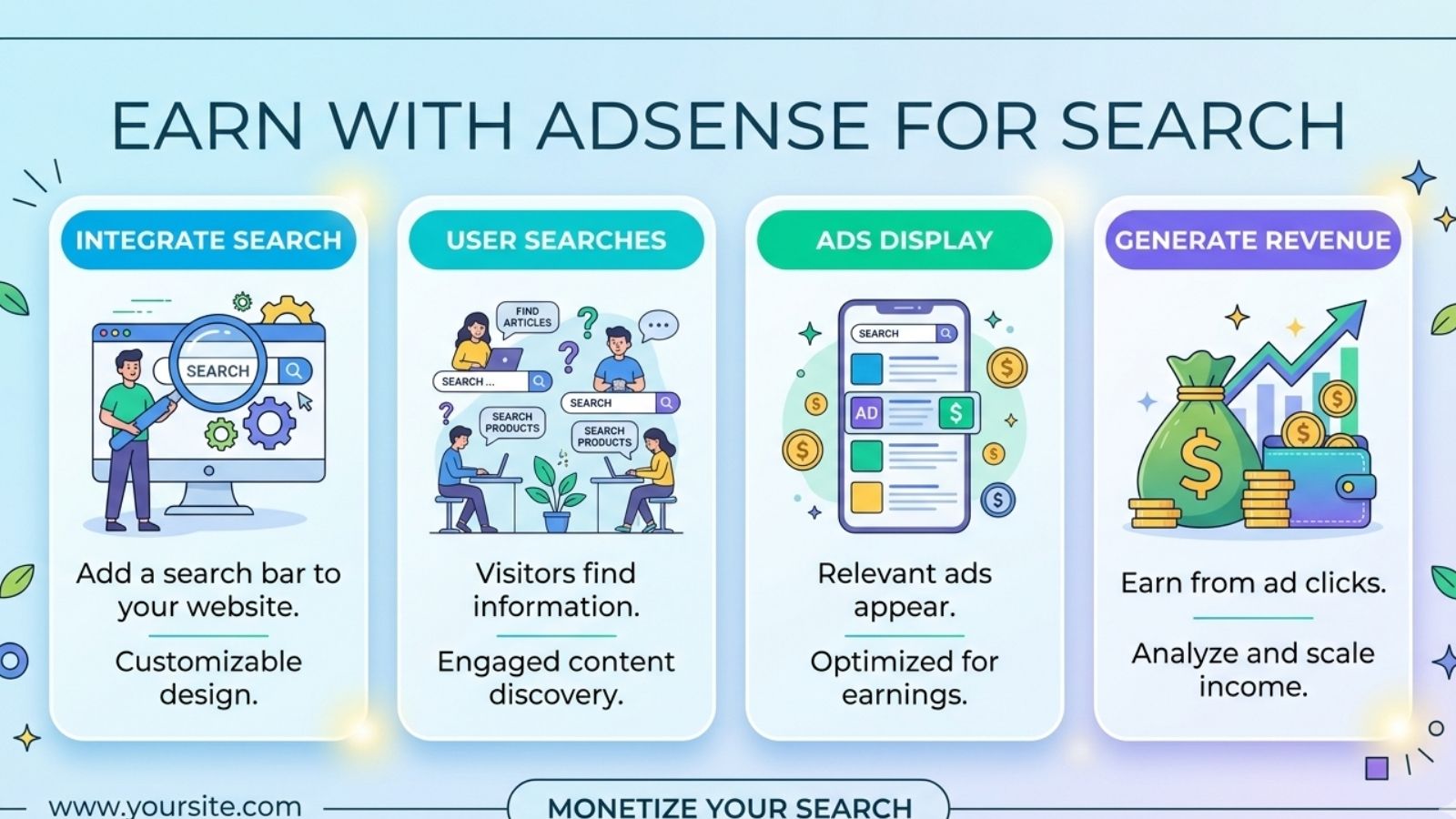
Earnings from AdSense for Search vary significantly based on niche, traffic quality, and optimization level—but a few key metrics will determine how much you actually make. In general, search results pages tend to deliver higher RPM (Revenue Per Mille) than standard display ads, typically ranging from $8 to $35+ per 1,000 impressions. This higher RPM comes from strong user intent, meaning people who search are more likely to click relevant ads.
Niches with strong commercial intent—such as finance, insurance, health, technology, and legal—consistently produce the best results due to higher CPC (cost-per-click) and advertiser competition. In these niches, RPM can sometimes exceed the average range. However, even in lower-competition niches, performance can still be solid if you optimize for the right keywords and user behavior.
For traffic benchmarks, a website with around 100,000 monthly organic visitors can generate approximately $500 to $3,500+ per month from AFS when optimized correctly. But this number is heavily influenced by several critical performance indicators:
1. Search Usage Rate: % of users who actually use your search box (higher = more impressions → more revenue)
2. CTR (Click-Through Rate): How often users click ads on search results pages
3. RPM: Core metric that combines traffic + monetization efficiency
4. Page Load Speed: Faster pages = better engagement and higher ad interaction
5. Ad Relevance: Better keyword targeting = higher CPC and CTR
Even small improvements in these metrics can create noticeable gains. For example, increasing your search usage rate from 5% to 10% can potentially double your AFS revenue without increasing traffic.
One of the biggest advantages of AFS is that it generates incremental revenue. It does not replace your existing AdSense for Content earnings but adds another monetization layer on top. When combined with strategies like affiliate marketing or display ads, AFS helps build a more diversified, stable, and scalable income system, especially for content-heavy websites.
Case Study: Increasing Search Usage to Boost AFS Revenue
One practical example comes from a content-based website that implemented small but strategic changes to its search functionality. Initially, the site had a search usage rate of only 6%, meaning very few users were interacting with the search box.
After optimizing the placement (moving it to the header and adding it below articles), improving visibility, and refining internal search suggestions, the site increased its search usage rate to 11% within 4 weeks.
Here’s a real-world example of how small optimizations can drive significant results:
1. Search impressions nearly doubled
2. AFS revenue increased by +80%
3. Overall RPM improved from ~$12 to ~$19
This case highlights a key insight: even without increasing traffic, improving how users interact with your search feature can significantly boost revenue. Small UX changes can lead to substantial gains when applied strategically.
Best Practices to Maximize AFS Revenue
Strategic placement is crucial for success when using AdSense for Search (AFS). Your search box should be positioned in highly visible areas where users naturally expect to interact, such as the header, navigation bar, sidebar, or even at the end of articles where readers are looking for more related information. In-content placements can also perform well if they are integrated naturally within the user journey rather than feeling forced or intrusive. The goal is to make search feel like a helpful feature, not just a monetization tool.
Equally important is the design and user experience of your search results pages. These pages should closely match your website’s overall branding, including colors, typography, spacing, and layout. A consistent look and feel helps build trust and ensures the transition from your content to the search results page feels seamless rather than disruptive. Avoid overly aggressive ad layouts that may harm user experience or violate Google policies.
Performance optimization is another key factor. Search result pages must load quickly and function smoothly across all devices, especially mobile. Slow-loading pages can significantly reduce user engagement and lower revenue potential. Clear navigation, well-structured results, and intuitive filtering (if applicable) will help users find what they need faster, increasing the likelihood of meaningful interactions.
To continuously improve performance, you should regularly analyze search query reports within your AdSense dashboard. These insights reveal what users are actively searching for on your site, allowing you to identify high-demand topics and content gaps. By creating in-depth, SEO-optimized content around popular queries, you not only increase organic traffic but also enhance the effectiveness of your AFS setup.
Combining AdSense for Search with a strong internal linking strategy can further boost engagement. Guide users toward related articles, categories, or cornerstone content to keep them on your site longer. The more pages users explore, the higher the chances of generating additional search activity and ad interactions.
Testing and iteration should also be part of your long-term strategy. Experiment with different placements, layouts, and design variations to determine what works best for your audience. Even small changes in positioning or styling can have a measurable impact on click-through rates and revenue.
Finally, and most importantly, always maintain strict compliance with Google’s policies. Avoid misleading placements, accidental clicks, or any attempt to artificially inflate engagement. Building a sustainable AFS revenue stream depends on maintaining a high-quality user experience and protecting your account from potential penalties or suspension.
Best For: Who Should Use AFS?
AFS is ideal for:
- Content-heavy websites
- Blogs and niche sites
- Review & comparison sites
- Educational platforms
- High-traffic SEO sites
👉 If users frequently search on your site, AFS is a strong fit.
AFS vs Other Monetization Methods
AdSense for Search offers a unique balance of high user intent strong revenue potential and relatively good user experience. Here is a detailed comparison:
| Method | Revenue Potential | Effort | Best Use Case |
|---|---|---|---|
| AFS | High | Medium | Intent-driven traffic |
| Display Ads | Medium | Low | Passive monetization |
| Affiliate | High | High | Product-driven content |
| Header Bidding | Very High | High | Large publishers |
Frequently Asked Questions about AFS
What is the main difference between AdSense for Search and AdSense for Content?
AdSense for Search monetizes active user search queries while AdSense for Content monetizes passive page views based on overall content topic.
Do I need an existing AdSense account to apply?
Yes an approved AdSense for Content account is required before you can apply for AdSense for Search.
How long does the approval process usually take?
Approval time ranges from several days to several weeks depending on Google’s review workload and your site quality.
Can new websites get approved for AdSense for Search?
New websites rarely qualify. Google prefers sites with established original content and consistent organic traffic.
Will implementing AFS negatively affect my SEO?
When done correctly it usually has a neutral or slightly positive impact due to improved user engagement and time on site.
Is AdSense for Search still worth implementing?
Yes it remains highly effective especially for sites with strong organic traffic and quality content in commercial niches.
How AdsCollab Helps You Implement AFS
Setting up AFS is not simple. It requires approval, technical setup, and optimization.
AdsCollab simplifies the process:
- AFS eligibility audit
- Application support
- Technical implementation
- UX optimization
- Performance tracking
👉 Explore our monetization solutions
👉 Improve performance with tracking & analytics
👉 Or contact our team for a free review
Final Thoughts
AdSense for Search represents a sophisticated way for publishers to extract greater value from their existing audience. When properly implemented and optimized it can become a reliable long-term revenue source that enhances rather than distracts from the overall user experience on your website.
This guide has covered the essential aspects of AdSense for Search from fundamental concepts to practical implementation strategies and performance optimization. Publishers who invest time in meeting Google’s quality standards and follow best practices consistently see meaningful returns from this powerful monetization feature.

