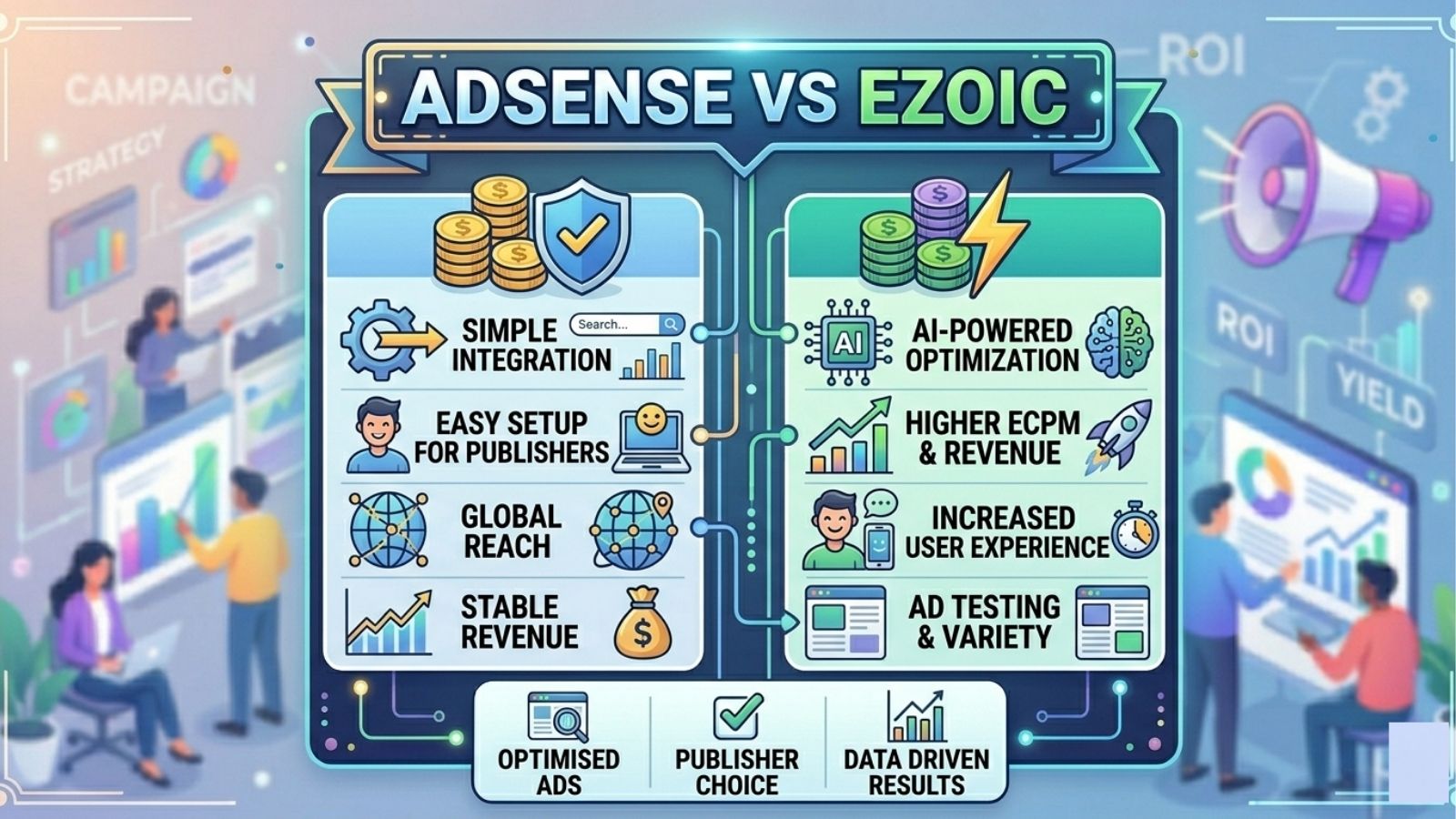
AdSense vs Ezoic - which ad network pays more in 2026? Discover a full side-by-side comparison of RPM, approval requirements, features, and revenue potential to help you make the right choice for your website.
If you're a publisher trying to monetize your website in 2026, you've almost certainly asked this question: AdSense vs Ezoic - which one should I use?
Google AdSense has been the go-to ad network for beginners for over two decades. It's simple, trusted, and backed by the world's largest advertising ecosystem. But Ezoic has emerged as a powerful AI-driven alternative that promises significantly higher revenue for the same amount of traffic.
The digital advertising landscape is evolving fast. With global digital ad spending projected to reach $786.2 billion in 2026, publishers who understand how to maximize their ad revenue will pull far ahead of those simply "installing AdSense and waiting." In this comprehensive guide, we break down AdSense vs Ezoic across every metric that matters - so you can make a smarter, data-backed decision.
Whether you're a new blogger or a growing content site looking to scale, this article covers everything you need to know.
What Is Google AdSense?
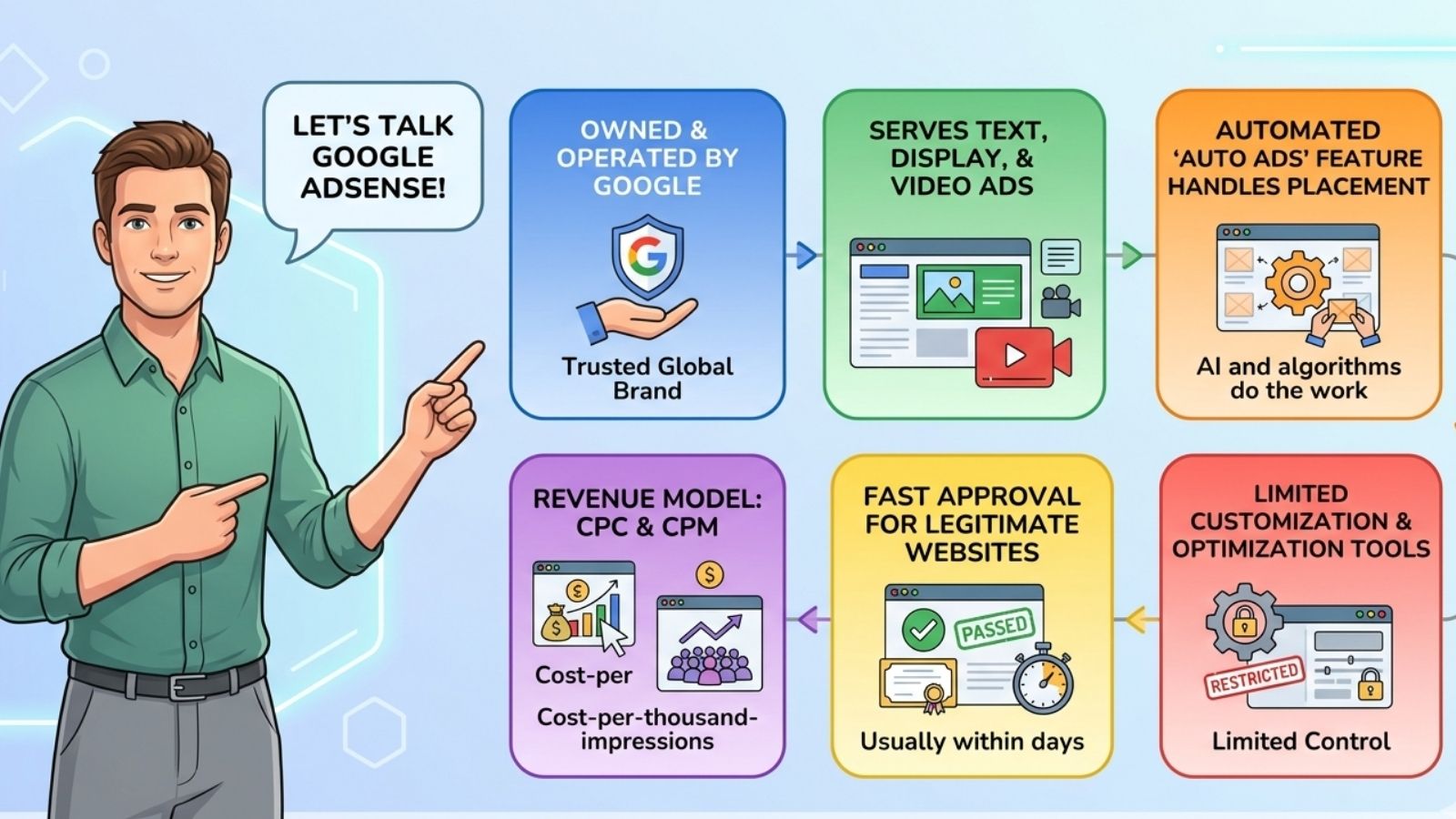
Google AdSense is Google's flagship ad monetization platform for publishers. It serves contextual ads based on your site's content and your visitors' interests. AdSense is trusted by over 40 million websites globally, making it the most widely used ad network in the world.
Key characteristics of AdSense:
- Owned and operated by Google
- Serves text, display, and video ads
- Automated "Auto Ads" feature handles placement
- Revenue model: Cost-per-click (CPC) and Cost-per-thousand-impressions (CPM)
- Fast approval for most legitimate websites
- Limited customization and optimization tools
AdSense is best described as a "set it and forget it" platform. While this makes it beginner-friendly, it also means you're leaving a significant amount of revenue on the table.
What Is Ezoic?
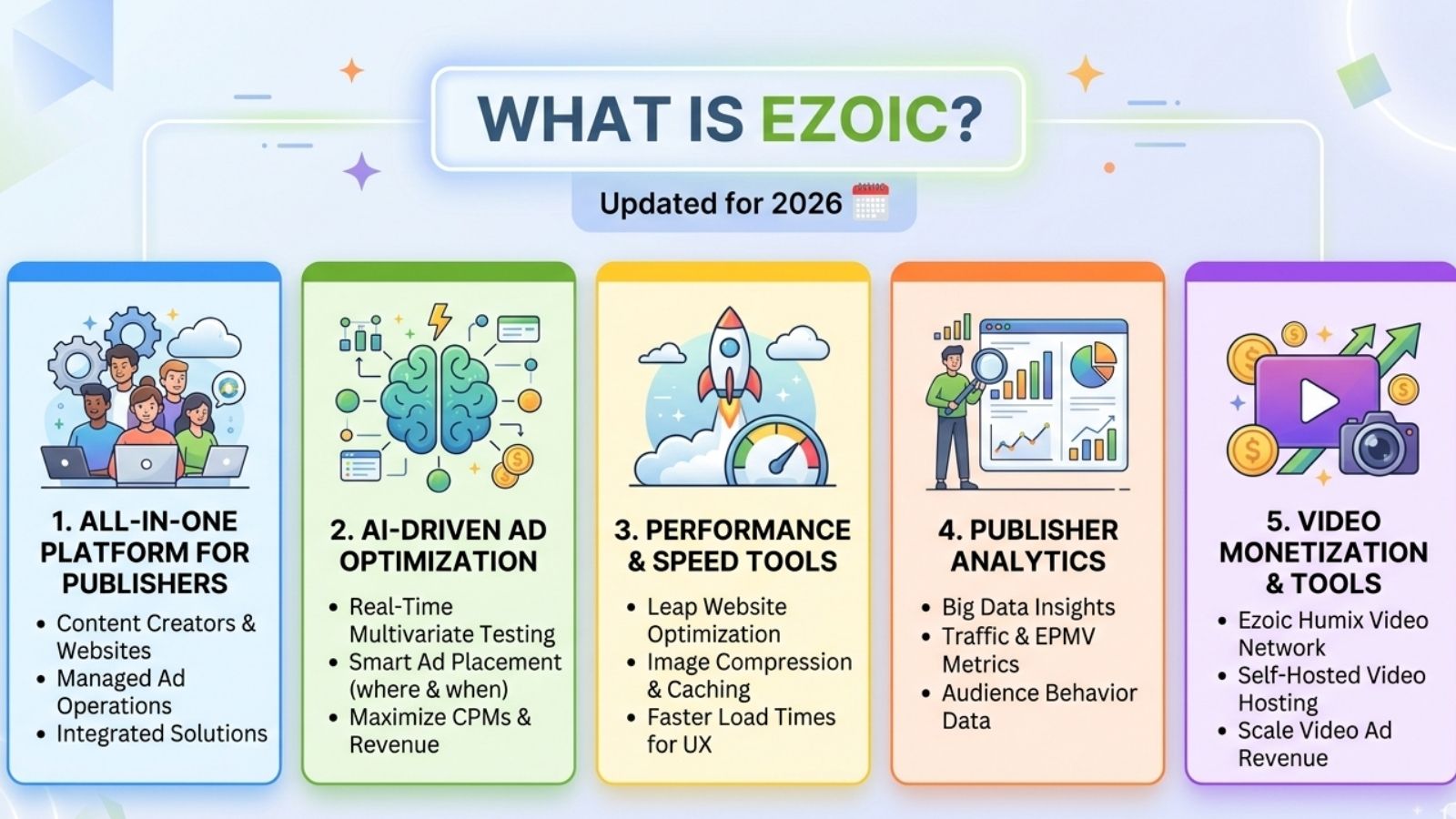
Ezoic is a Google-certified publishing partner and AI-powered ad technology platform. Rather than replacing AdSense, Ezoic layers on top of it - adding header bidding, access to premium ad networks like Google Ad Exchange (AdX), and machine learning-driven ad placement optimization.
Key characteristics of Ezoic:
- Uses AI and machine learning to optimize ad placements in real time
- Provides access to multiple ad demand sources (Google AdX, Rubicon, Amazon Header Bidding, and more)
- Offers analytics tools, site speed tools (Ezoic Leap), and video monetization (Humix)
- Revenue model: Takes 10% of your monthly ad revenue (Standard plan)
- Requires a functional AdSense account in good standing
Ezoic positions itself not just as an ad network, but as a full publishing technology platform - helping you grow revenue, speed, and audience insights simultaneously.
AdSense vs Ezoic: Full Side-by-Side Comparison
| Feature | Google AdSense | Ezoic |
|---|---|---|
| Ease of Setup | Very Easy | Moderate (DNS or plugin integration) |
| Approval Requirements | Quality content + valid traffic | AdSense account in good standing + quality content |
| Minimum Traffic | No strict minimum | No strict minimum (Access Now program) |
| Average RPM | $3 – $10 | $10 – $25+ |
| Revenue Optimization | Manual / Auto Ads | AI-driven, real-time A/B testing |
| Ad Networks Access | Google Ads only | Google AdX, Rubicon, Amazon, and more |
| Header Bidding | ❌ Not available | ✅ Available |
| Analytics & Reporting | Basic (Google Analytics integration) | Advanced Big Data Analytics dashboard |
| Site Speed Tools | Minimal impact | Ezoic Leap (dedicated speed optimizer) |
| Video Monetization | Limited | Humix video platform |
| Customer Support | Very limited | Dedicated support, chat, email |
| Revenue Share | Publisher keeps ~68% | Publisher keeps 90% (10% fee) |
| Contract / Lock-in | No contract | No contract for Standard; Premium requires 1-year |
| Best For | Beginners, low-traffic sites | Growing sites focused on revenue growth |
Revenue Comparison: How Much More Can You Earn with Ezoic?
This is the question every publisher wants answered. Let's look at the data.
RPM Benchmarks in 2026
- AdSense RPM typically ranges from $3 to $10 per 1,000 page views, with most general content sites sitting in the $5–$8 range.
- Ezoic RPM typically ranges from $10 to $25+, depending on niche, traffic quality, and optimization level.
The revenue gap is significant. A site receiving 100,000 monthly page views could earn approximately:
- AdSense: $500 – $800/month
- Ezoic: $1,000 – $2,500/month
Real-World Case Study
One of Ezoic's most compelling published case studies involves a history content website. After switching from AdSense to Ezoic:
- Monthly revenue jumped 248% - from $7,764 to $27,005
- Page RPM improved 237% - from $5.81 to $19.60
- Impression RPM increased 185% - from $1.54 to $4.39
- Additional $5,900/month was generated through Humix video ads
These results came despite a slight dip in overall sessions, proving that the revenue increase was driven entirely by better monetization - not more traffic.
The key driver? Header bidding - a technology that allows multiple ad exchanges including Google Ad Exchange, Rubicon, and Amazon to compete simultaneously for ad inventory, driving bid prices up significantly.
How Each Platform Optimizes Ads
Understanding how each platform places and optimizes ads is critical to understanding the revenue difference.
AdSense Ad Optimization
- Uses "Auto Ads" which automatically places ads based on Google's algorithm
- Publishers can manually place ad units on their pages
- Very limited A/B testing capability
- No access to external demand sources outside Google Ads
Ezoic Ad Optimization
Ezoic uses a sophisticated system called Ad Tester, which works through "placeholders" - potential ad spots across your site. The AI then:
- Tests different ad combinations for different visitor types
- Analyzes user behavior, device type, and engagement signals
- Selects the optimal ad layout to maximize both revenue and user experience
- Continuously refines placements as it collects more data
The result is a dynamic, visitor-specific ad experience that improves over time - something AdSense's static approach simply cannot match.
Step-by-Step: How to Switch from AdSense to Ezoic
If you've decided to give Ezoic a try, here's a clear path to getting started:
Step 1: Ensure Your AdSense Account Is in Good Standing Ezoic requires you to have an active, approved AdSense account. If you've been banned from AdSense, you cannot use Ezoic.
Step 2: Sign Up for Ezoic Visit Ezoic's website and create a publisher account. If your site has fewer than 10,000 monthly page views, you'll be enrolled in the Access Now program, which includes training and onboarding support.
Step 3: Integrate Ezoic with Your Site The recommended method is via DNS integration - pointing your domain through Ezoic's servers. This is the most efficient and technically stable setup. Ezoic also integrates seamlessly with Cloudflare. Alternatively, a WordPress plugin or JavaScript snippet can be used.
Step 4: Set Up Ad Placeholders Instead of placing fixed ad units, you'll define "placeholder zones" across your site - header, sidebar, in-content, footer, etc. Ezoic's AI will test which of these zones perform best.
Step 5: Configure Ezoic Leap for Site Speed Enable Ezoic Leap to ensure that additional ad code doesn't slow down your site. Properly configured, Ezoic Leap can help you maintain or improve Core Web Vitals scores.
Step 6: Let the AI Optimize (Allow 2–4 Weeks) Ezoic's machine learning needs time to collect data and learn your audience. Don't judge results in the first week. Revenue typically ramps up significantly after the first 30 days of optimization.
Step 7: Monitor Performance via Big Data Analytics Use Ezoic's built-in analytics dashboard to track EPMV (Earnings Per Thousand Visitors), RPM by page, ad location performance, and more.
Who Is Each Platform Best For?
✅ Google AdSense Is Best For:
- Complete beginners launching their first website
- Sites with very low traffic (under 5,000 monthly visitors)
- Publishers who want a zero-setup, passive monetization solution
- Websites that don't rely primarily on ad revenue (e.g., e-commerce sites with a blog section)
- Publishers who want no revenue share fee (though lower RPM usually means less total revenue)
✅ Ezoic Is Best For:
- Growing content publishers with 5,000+ monthly visitors
- Publishers whose primary revenue source is display ads
- Sites focused on maximizing RPM without significantly increasing traffic
- Bloggers and niche site owners ready to invest time in setup for long-term payoff
- Publishers who want access to advanced analytics, video monetization, and site speed tools under one platform
Pros and Cons of Each Platform
Google AdSense - Pros & Cons
Pros:
- Extremely easy to set up and use
- Backed by Google's massive ad inventory
- No long-term contract
- Great starting point for new publishers
Cons:
- RPM ceiling is significantly lower than Ezoic
- No access to external demand sources or header bidding
- Very limited customer support
- Revenue often stagnates even as traffic grows
Ezoic - Pros & Cons
Pros:
- Significantly higher RPM potential (often 2–5x AdSense)
- AI-driven optimization improves revenue over time automatically
- Access to multiple premium ad demand sources
- Comprehensive analytics and reporting tools
- Site speed optimization (Ezoic Leap) included
- Video monetization via Humix
- No strict traffic minimum (Access Now program)
- Dedicated customer support
Cons:
- Setup is more technically involved than AdSense
- Requires an existing AdSense account in good standing
- 10% revenue fee on Standard plan
- Premium tier requires a 12-month contract
- Approval is selective - thin or auto-generated content will be rejected
Frequently Asked Questions (FAQ)
Q: Can I use AdSense and Ezoic at the same time? Yes. Ezoic integrates with AdSense as one of its demand sources. When you join Ezoic, your AdSense account continues to compete alongside other ad networks in a header bidding auction, meaning AdSense ads still show when they win the highest bid.
Q: Does Ezoic hurt my site speed? Not when set up correctly. Ezoic includes a dedicated site speed product called Ezoic Leap, and when combined with proper DNS integration, many publishers report maintaining or improving their Core Web Vitals scores.
Q: How long does it take to see revenue improvement on Ezoic? Most publishers start seeing noticeable improvements within 2–4 weeks as the AI collects data and optimizes placements. Full optimization typically takes 60–90 days.
Q: Is Ezoic free to use? Ezoic's Standard plan takes 10% of your monthly ad revenue as its platform fee. The Ezoic Premium plan has a monthly subscription cost but often guarantees a return on investment through higher RPMs. There are no upfront fees to join.
Q: What happens if I get rejected by Ezoic? If Ezoic rejects your application, it's typically due to content quality issues. Focus on building original, high-value content, growing your organic traffic, and reapplying after a few months.
Q: Do I need a lot of traffic to join Ezoic? No. Ezoic's Access Now program removed the previous 10,000 monthly sessions requirement. However, approval is still based on content quality and site legitimacy.
Final Verdict: AdSense vs Ezoic in 2026
For publishers who are serious about growing ad revenue, Ezoic is the clear winner in 2026. The platform's AI optimization, access to premium ad demand through header bidding, and advanced analytics give it a massive revenue advantage over AdSense for virtually any content site.
AdSense remains the ideal starting point - low friction, easy to set up, and a great way to begin monetizing while you grow. But once your site gains consistent organic traffic, staying on AdSense alone means leaving significant revenue on the table.
The smart approach for most publishers in 2026: start with AdSense, then migrate to Ezoic as your content and traffic mature. If you're looking to scale your ad revenue without necessarily scaling your traffic, Ezoic gives you the tools to do exactly that.
For more insights on ad monetization strategies, publisher tools, and digital marketing tips, explore the resources available at Adscollab - a trusted source for publishers looking to grow their revenue intelligently.
Contact us now if you're already running paid campaigns alongside organic monetization, understanding how to balance ad spend and ad revenue strategies on adscollab can give you a significant competitive edge in today's crowded publishing landscape.

