Header bidding vs Open Bidding is one of the most important comparisons publishers need to understand when optimizing their programmatic revenue. Both solutions aim to increase competition for ad inventory, but they work in very different ways.
In this guide, we’ll clearly explain the differences between header bidding and Google Open Bidding, and help you decide which approach (or combination) is better for your site.
What Is Header Bidding?
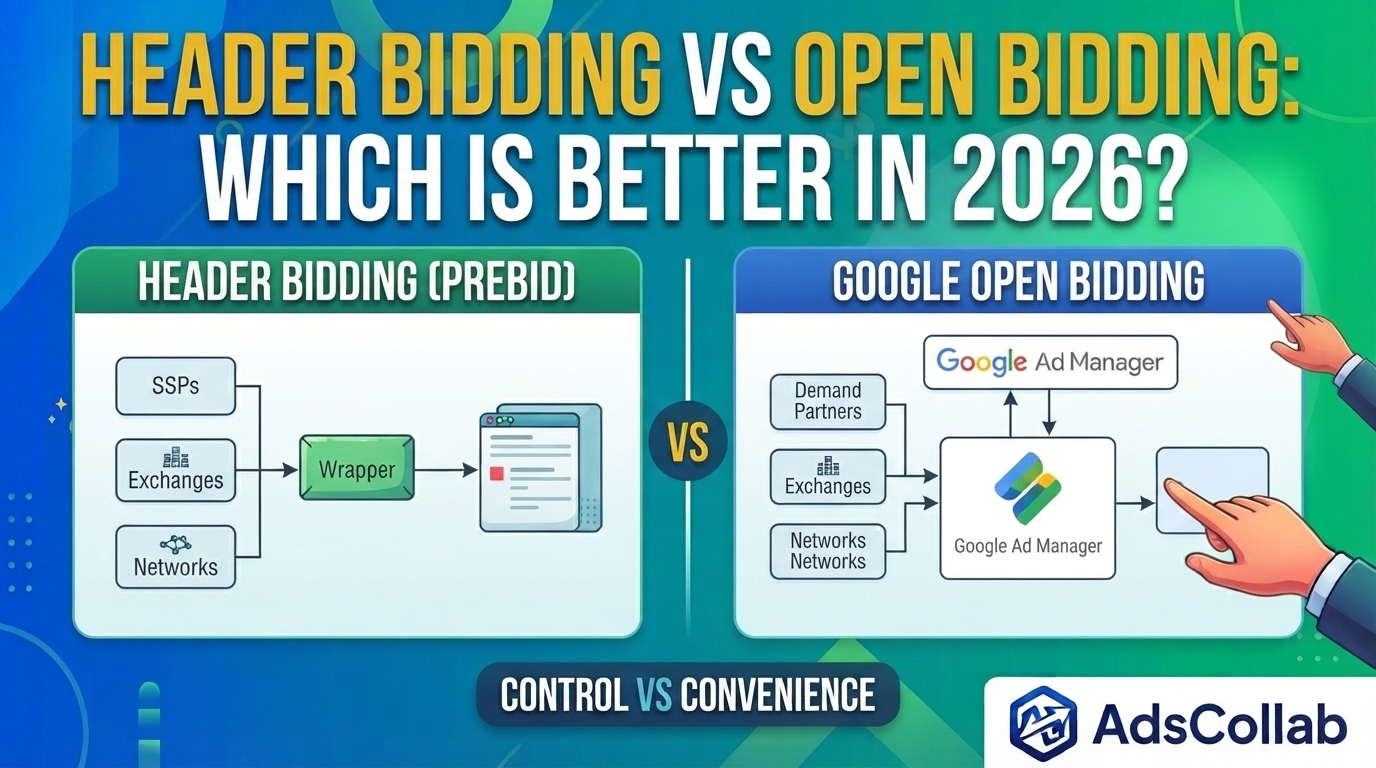
Header bidding is a technique that allows multiple demand partners (SSPs, exchanges, and ad networks) to bid on the same ad impression before the ad server makes its decision.
There are two main types:
- Client-side header bidding (usually powered by Prebid.js): The auction happens in the user’s browser.
- Server-side header bidding (Prebid Server or similar): The auction happens on a server to reduce page latency.
With header bidding, publishers can invite many demand partners to compete simultaneously, which usually leads to higher CPMs compared to the old waterfall model.
What Is Open Bidding?
Open Bidding (formerly known as Exchange Bidding or EBDA) is Google’s server-side header bidding solution that runs inside Google Ad Manager.
It allows approved third-party demand partners to compete in a unified auction alongside Google Ad Exchange. The entire process happens on Google’s servers, so it has less impact on page load speed than traditional client-side header bidding.
Header Bidding vs Open Bidding: Key Differences
|
Feature |
Header Bidding (Prebid) |
Google Open Bidding |
|
Who controls it |
Publisher / Prebid community |
|
|
Where the auction runs |
Browser (client-side) or publisher’s server |
Google’s servers |
|
Transparency |
High (especially with Prebid.js) |
Limited |
|
Latency impact |
Higher with client-side |
Lower (server-side) |
|
Demand partners |
300+ available |
Limited to Google-approved partners |
|
Fees |
Free (Prebid) + partner fees |
Google takes a revenue share |
|
Setup complexity |
Medium to high |
Relatively easier |
|
Best for |
Publishers who want maximum control |
Publishers already deep in Google Ad Manager |
Pros and Cons
Header Bidding Advantages
Header bidding remains popular because it gives publishers more control and stronger competition in the ad auction. Below are the main advantages of using a header bidding setup.
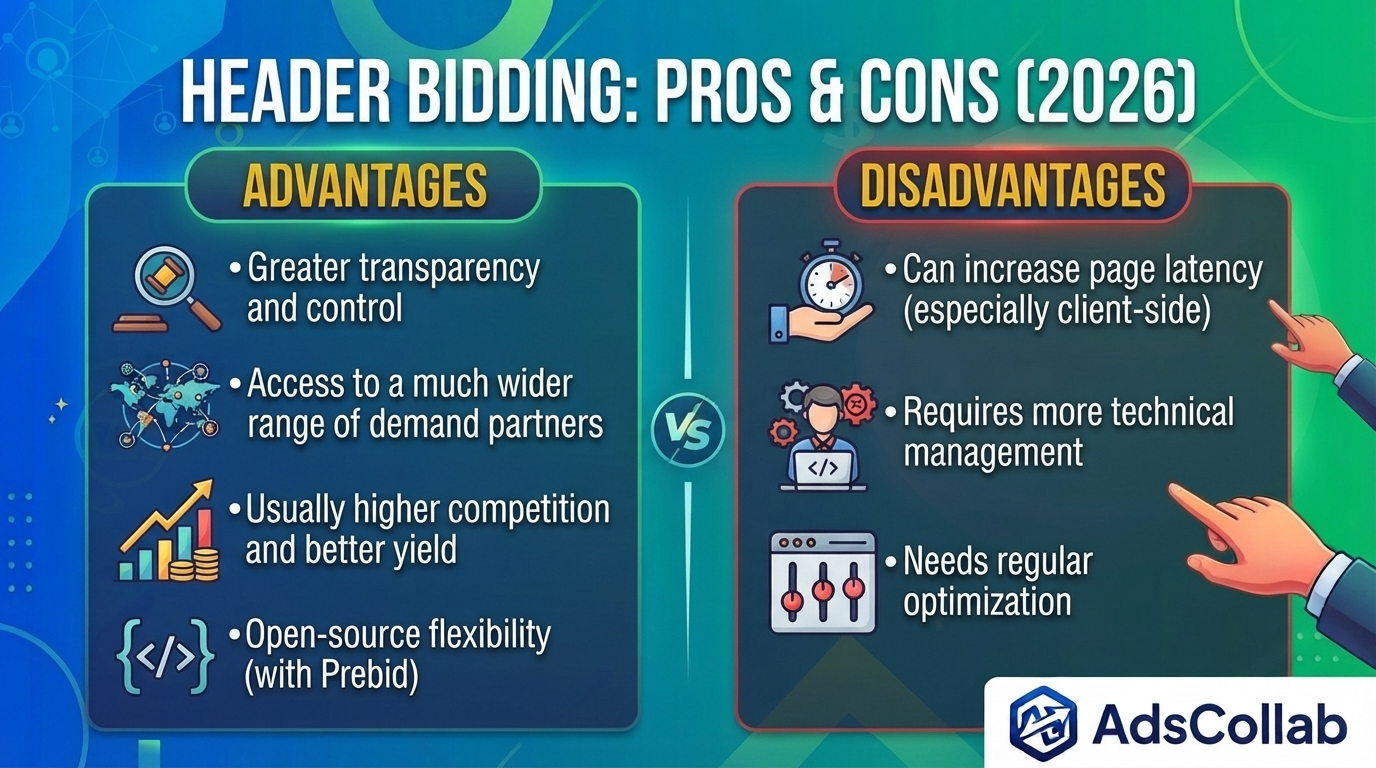
• Greater transparency and control
Header bidding generally provides publishers with more visibility into the auction process. You can see which demand partners are bidding, how the auction is structured, and how different partners perform. This higher level of control makes it easier to adjust configurations and optimize results.
• Access to a much wider range of demand partners
One of the strongest benefits of header bidding is the ability to connect with a broad range of demand sources. Instead of relying mainly on one ecosystem, publishers can bring multiple SSPs and exchanges into the auction, increasing the number of buyers competing for their inventory.
• Usually higher competition and better yield
When more demand partners participate in the auction, competition tends to increase. This often leads to stronger bids and improved overall yield compared with setups that rely on a more limited pool of buyers.
• Open-source flexibility (with Prebid)
Frameworks like Prebid give publishers a high degree of flexibility. Because the technology is open-source, teams can customize bidding logic, timeouts, partner setups, and other technical details to better match their monetization goals.
Header Bidding Disadvantages
Despite its strengths, header bidding also comes with operational and technical challenges that publishers should consider.
• Can increase page latency (especially client-side)
Client-side header bidding runs in the user’s browser, which means multiple bid requests can slow down page loading if not carefully managed. Without proper timeout settings and optimization, this added latency may negatively affect user experience.
• Requires more technical management
Header bidding is more complex to implement and maintain than simpler monetization setups. Publishers often need technical resources to manage wrappers, partners, troubleshooting, and ongoing configuration changes.
• Needs regular optimization
A header bidding setup is not something you can launch and ignore. To maintain strong performance, publishers need to monitor results, test partner combinations, adjust timeouts, and continuously refine the stack.
While header bidding offers strong competition and control, it also comes with added technical complexity and potential performance trade-offs. For publishers looking for a simpler alternative within the Google ecosystem, Open Bidding presents a different approach with its own set of strengths and limitations.
Open Bidding Advantages
Open Bidding offers a more streamlined approach, especially for publishers already working within the Google ecosystem. Here are its main advantages.
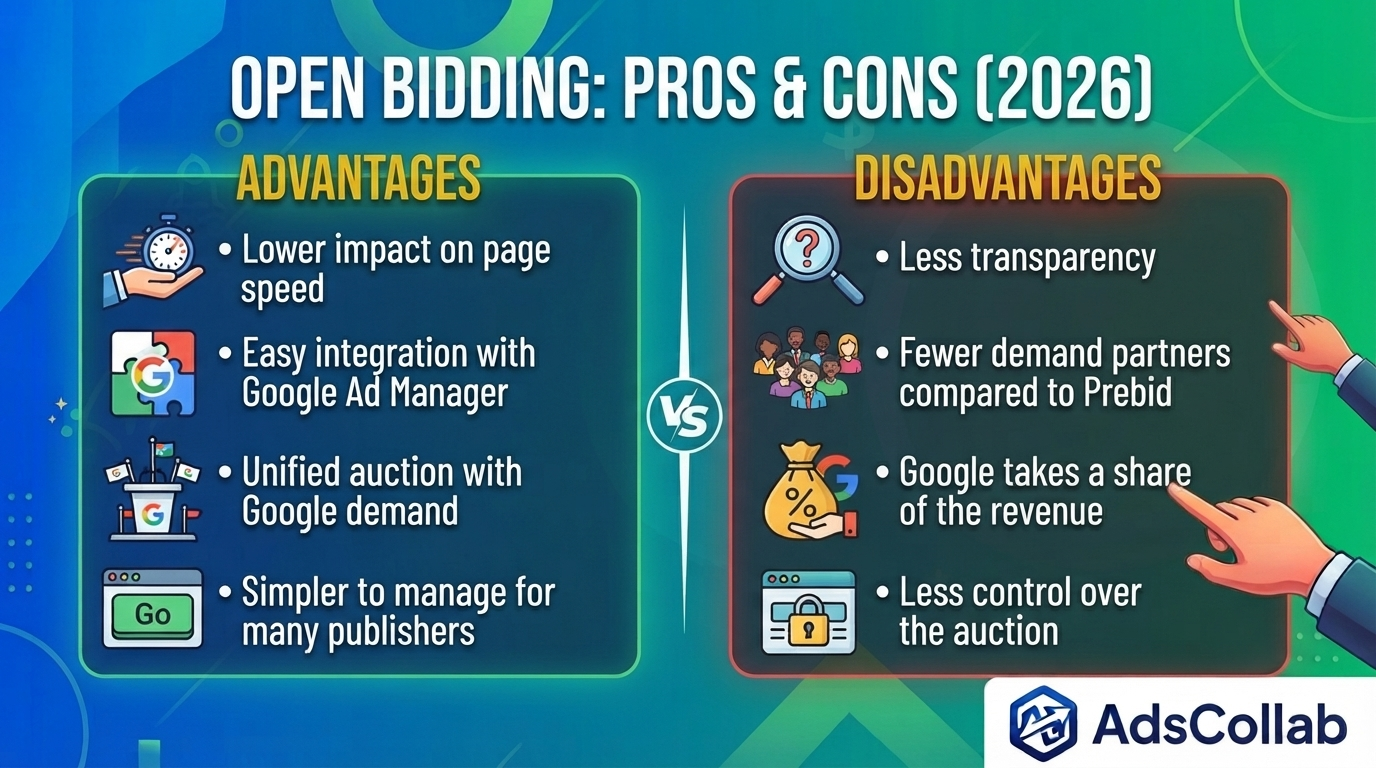
• Lower impact on page speed
Because Open Bidding operates in a server-side environment, it generally has less impact on page load time than client-side header bidding. This can help preserve a better user experience while still allowing additional demand to compete.
• Easy integration with Google Ad Manager
Open Bidding is designed to work smoothly with Google Ad Manager. For publishers already using GAM, the integration process is relatively straightforward and requires less custom development than a full header bidding wrapper.
• Unified auction with Google demand
One of the key benefits is that external demand can compete in a more unified auction environment alongside Google’s own demand. This helps simplify the auction process while still introducing additional buyers.
• Simpler to manage for many publishers
Compared with a fully custom header bidding setup, Open Bidding is often easier to manage. Publishers with limited technical resources may prefer this approach because it reduces the complexity of ongoing maintenance.
Open Bidding Disadvantages
While Open Bidding is convenient, it also has limitations that can affect transparency and long-term control.
• Less transparency
Open Bidding typically provides less visibility into the auction process than open-source header bidding frameworks. Publishers may have fewer insights into partner-level performance and bid dynamics.
• Fewer demand partners compared to Prebid
Although Open Bidding allows additional demand sources to participate, the overall range of available partners is generally more limited than what a mature Prebid setup can support.
• Google takes a share of the revenue
Because Open Bidding runs through Google’s infrastructure, Google takes a portion of the revenue. This fee structure can reduce the final amount publishers receive compared with more independent setups.
• Less control over the auction
Publishers using Open Bidding usually have less direct control over how the auction is configured. Customization options are more limited, which may be a drawback for teams that want full ownership of their monetization stack.
Which One Should You Choose?
Most sophisticated publishers in 2026 do not rely on only one monetization method. Instead of choosing between header bidding and Open Bidding, they often use a hybrid setup that brings together the strengths of multiple solutions. This approach is designed to maximize demand competition while still maintaining a practical balance between revenue, control, and page performance.
• Run Prebid.js or Prebid Server for maximum demand competition
Many publishers use Prebid.js on the client side or Prebid Server for server-side bidding to bring a wide range of demand partners into the auction. This helps increase competition for inventory and gives publishers more flexibility in how they manage and optimize their demand sources.
• Keep Google Open Bidding active inside Google Ad Manager
Even when using Prebid, many publishers continue to run Google Open Bidding within Google Ad Manager. This allows Google demand and additional Open Bidding partners to compete in a unified auction environment, helping maintain strong fill and simplifying part of the monetization stack.
• Often add Amazon TAM as another strong demand source
Amazon Transparent Ad Marketplace (TAM) is frequently added as another major demand source. For many publishers, Amazon provides valuable incremental competition and can further improve overall yield when combined with Prebid and Open Bidding.
This hybrid combination usually delivers the best balance of revenue, latency, and control. By using multiple systems together, publishers can increase competition without depending entirely on a single platform or auction model.
Final Thoughts
When comparing header bidding vs Open Bidding, the key difference comes down to control versus convenience.
- Choose header bidding (Prebid) if you want maximum transparency, more demand partners, and higher potential yield.
- Choose Open Bidding if you prefer simplicity, lower latency, and already rely heavily on Google Ad Manager.
- For most publishers, the smartest strategy is to use both together.
For more guides on header bidding, Open Bidding, and ad monetization strategies, you can visit adscollab.com.
Are you currently using header bidding, Open Bidding, or a hybrid setup? Share your experience in the comments!

