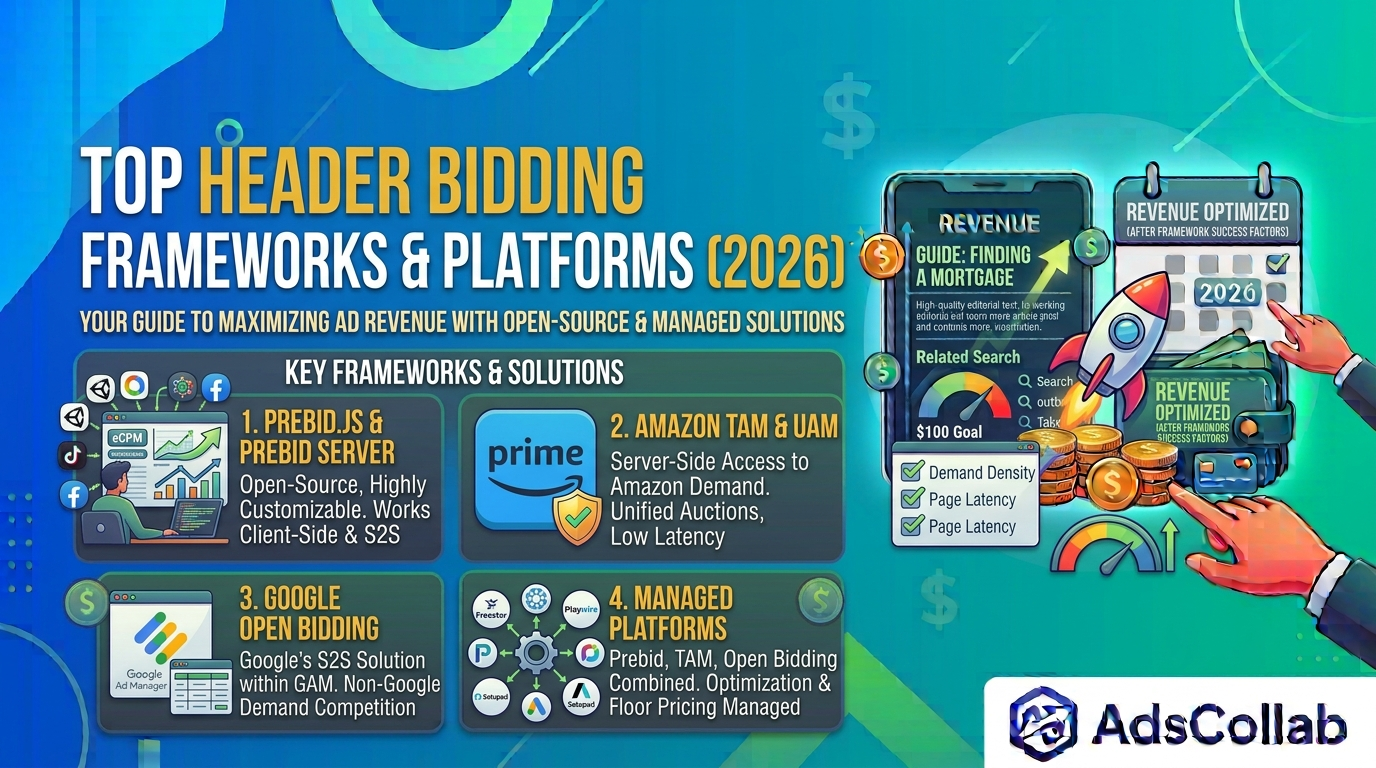
Header bidding has become the standard way for publishers to maximize ad revenue by allowing multiple demand partners to compete for the same impression in real time. In 2026, the landscape is dominated by a mix of open-source frameworks and major platform solutions.
In this guide, we cover the top header bidding frameworks and platforms that publishers should consider.
1. Prebid.js & Prebid Server
Prebid remains the most widely used open-source header bidding framework in the industry.
- Prebid.js runs client-side in the browser.
- Prebid Server handles server-to-server (S2S) bidding.
Key advantages:
Prebid continues to stand out as one of the most flexible and widely adopted header bidding solutions available today. Its open-source nature and strong ecosystem make it a preferred choice for many publishers looking to improve competition and control over their ad stack. Below are some of its most important advantages:
• Completely free and open-source
One of Prebid’s biggest strengths is that it is completely free to use. As an open-source framework, publishers can implement and customize it without paying licensing fees, which makes it accessible to both small and large publishers.
• Supports 300+ demand partners
Prebid offers broad demand connectivity, with support for more than 300 demand partners. This wide range of integrations helps publishers increase competition for their inventory and improve the chances of higher bids.
• Highly customizable
The framework is highly flexible and can be tailored to fit different publisher needs. Teams can adjust bidding logic, timeout settings, partner configurations, and other elements to better match their monetization strategy.
• Strong community and continuous updates
Prebid benefits from an active global community of developers and publishers. Regular updates, shared best practices, and ongoing contributions help the framework stay current with industry changes and technical improvements.
• Works for web, AMP, and mobile apps
Prebid is not limited to standard websites. It also supports AMP pages and mobile app environments, allowing publishers to apply a more consistent header bidding approach across different platforms.
2. Amazon Transparent Ad Marketplace (TAM)
Amazon TAM is one of the strongest server-side header bidding solutions, especially for larger publishers.
It allows publishers to access Amazon’s demand along with other third-party partners in a unified auction. TAM is known for good transparency, strong brand demand, and relatively low latency compared to pure client-side solutions.
Many publishers run Amazon TAM alongside Prebid for hybrid setups.
3. Google Open Bidding
Google Open Bidding (formerly Exchange Bidding) is Google’s server-side header bidding solution that runs inside Google Ad Manager.
It lets non-Google demand partners compete in a unified auction alongside Google Ad Exchange. While it is convenient for publishers already using Google Ad Manager, it offers less transparency and control compared to Prebid.
4. Amazon Unified Ad Marketplace (UAM)
Amazon UAM is designed more for small and mid-sized publishers. It provides a simpler dashboard-based solution for managing header bidding auctions and integrating demand partners.
UAM is easier to implement than TAM but generally offers less advanced features and scale.
5. Managed Header Bidding Platforms
Besides pure frameworks, many publishers use managed services that handle header bidding on their behalf. Popular options in this category include:
- Playwire
- Snigel
- Setupad
- Freestar
- Raptive (for qualifying publishers)
- Ezoic (for smaller sites)
These platforms typically combine Prebid, Amazon TAM, Google Open Bidding, and additional demand partners while managing optimization, floor pricing, and reporting.
|
Type |
Examples |
Pros |
Cons |
|
Client-side |
Prebid.js |
Higher bid density, more control |
Can increase page latency |
|
Server-side |
Prebid Server, TAM, Open Bidding |
Lower latency, better for mobile |
Slightly less transparency |
|
Hybrid |
Prebid + TAM + Open Bidding |
Best of both worlds |
More complex to manage |
.
How to Choose the Right Header Bidding Solution

Choosing the right header bidding solution depends on your publisher setup, technical capacity, and monetization goals. Not every platform is the best fit for every site, so it is important to evaluate your needs carefully before making a decision. Below are the key points to consider.
• Your monthly traffic volume
Traffic size plays an important role in selecting the right header bidding setup. High-traffic publishers may benefit from more advanced or enterprise-level solutions that can handle large bid volumes efficiently, while smaller sites may prefer lighter frameworks that are easier to manage and less resource-intensive.
• Technical resources (in-house team vs managed service)
Your available technical resources should guide your choice. If you have an experienced in-house team, an open-source solution like Prebid can offer greater flexibility and control. If you lack dedicated developers, a managed header bidding platform may be a better option because it reduces the need for complex setup and ongoing maintenance.
• Need for transparency and control
Some publishers prioritize full transparency into the auction process, demand partners, and bid data. Open-source frameworks generally provide more visibility and customization, while certain managed platforms may offer convenience at the cost of reduced control. Consider how much visibility you need into your monetization stack.
• Existing relationship with Google Ad Manager or Amazon
Your current ad stack can influence the best choice. Publishers already working closely with Google Ad Manager or Amazon Publisher Services may prefer solutions that integrate smoothly with those ecosystems. Compatibility with your existing tools can reduce implementation friction and improve overall performance.
• Desired balance between revenue and page speed
Header bidding can increase competition and revenue, but adding too many demand partners may also affect page load time. It is important to find a balance that improves yield without harming user experience. The right framework should allow you to optimize both monetization and site performance.
Final Thoughts
The top header bidding frameworks and platforms in 2026 are led by Prebid, Amazon TAM, and Google Open Bidding. While Prebid offers the most flexibility and control, Amazon and Google provide strong demand and easier server-side options.
Many successful publishers combine multiple solutions in a hybrid setup to maximize both competition and performance. For more guides on header bidding, ad monetization, and revenue optimization strategies, you can visit adscollab.com.
Which header bidding setup are you currently using? Share your experience in the comments!

