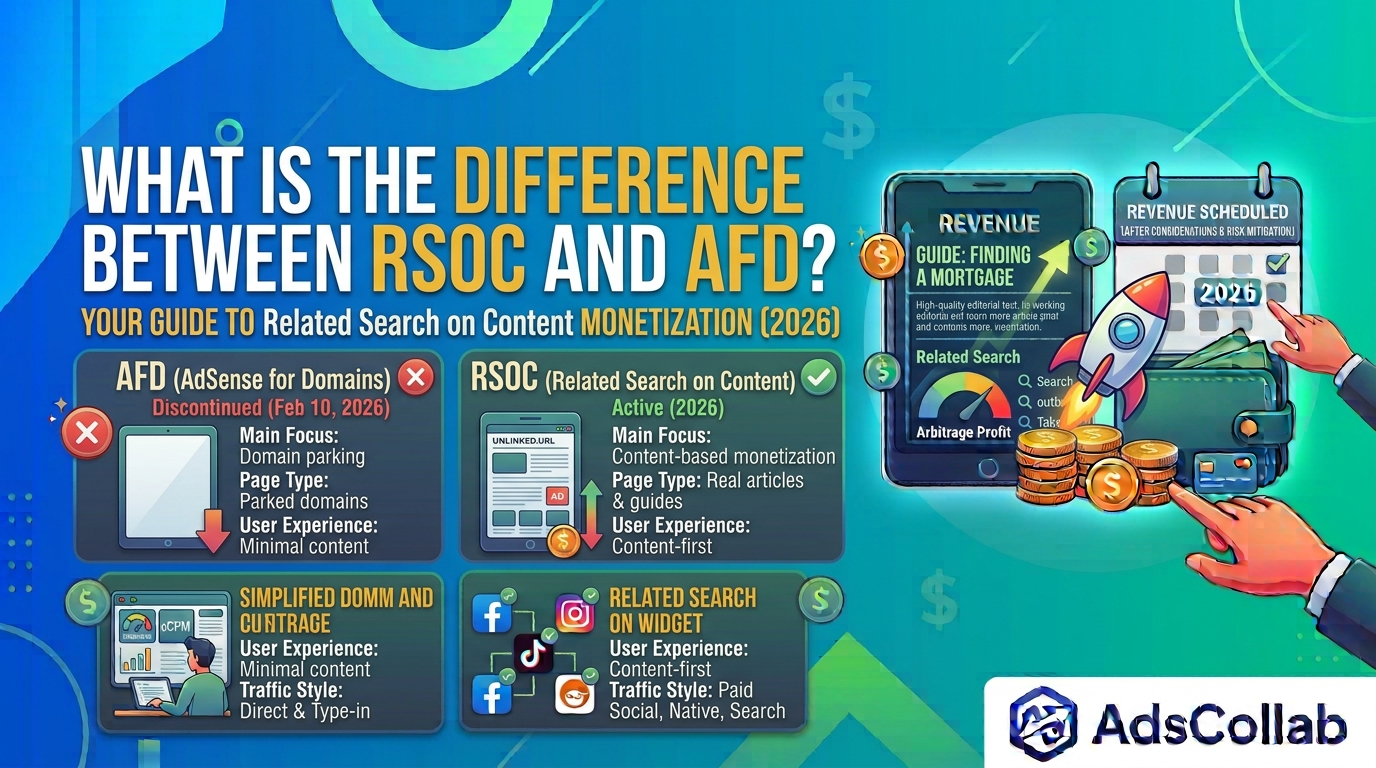
What is the difference between RSOC and AFD? This is one of the most common questions among publishers and media buyers involved in search monetization. Both products were created by Google, but they work in very different ways — and one of them no longer exists.
In this guide, we’ll clearly explain the key differences between RSOC (Related Search on Content) and AFD (AdSense for Domains), and why the industry has shifted from one to the other.
What Is AFD (AdSense for Domains)?
AFD stood for AdSense for Domains. It was Google’s older domain-parking monetization product.
With AFD, domain owners could point undeveloped or parked domains to Google’s servers. Google would then display ads based on the domain name and the visitor’s search intent. These pages usually contained little to no real content — mostly ads and related links.
AFD was popular for many years because it required almost no content creation. However, Google officially ended AdSense for Domains on February 10, 2026.
What Is RSOC (Related Search on Content)?
RSOC stands for Related Search on Content. It is a Google AdSense for Search format that places relevant search suggestions inside real content pages (articles, guides, comparison posts, etc.).
When a visitor clicks one of the suggested search terms, they are taken to a search results page that contains ads. The publisher earns a share of the revenue from those ad clicks.
Unlike AFD, RSOC requires actual editorial content and focuses on user experience.
Key Differences Between RSOC and AFD
Here is a clear comparison of the two models:
• Page Type
AFD was typically used on parked or undeveloped domains that had little to no original content. These pages often consisted of basic templates filled with ads and search boxes, with almost no real information or value for visitors.
RSOC is designed for real content pages such as blog posts, in-depth articles, guides, and informational resources. It works best on websites that already provide useful, readable content and then enhance those pages with related search suggestions.
• User Experience
AFD pages were mostly filled with advertisements and offered minimal content, which often resulted in a weak and cluttered user experience. Visitors landing on these pages usually encountered limited information and were quickly pushed toward ads.
RSOC prioritizes a content-first approach. It combines useful articles with relevant search suggestions, creating a more natural and helpful browsing experience. Users can read meaningful content while still having the option to explore related topics through suggested searches.
• Traffic Style
AFD mainly relied on direct navigation and type-in traffic, where users typed domain names directly into the browser. This model depended heavily on leftover traffic from expired or undeveloped domains.
RSOC works more effectively with paid social traffic, native advertising, and organic content traffic. Because it is built around real articles, it performs better when users arrive from social media, content discovery platforms, or search engines looking for genuine information.
• Content Requirement
AFD had a very low content requirement and could operate on pages with almost no editorial value. In many cases, a simple landing page with ads and links was enough to run the model.
RSOC requires high-quality, real editorial content to perform well and remain compliant. Publishers need to create original articles, guides, or informational posts that provide actual value to readers before monetizing them with related search units.
• Click Path
AFD usually offered a shorter and more direct click path. Users often went from the domain straight to ad listings or search results with very few steps in between.
RSOC involves a slightly longer click path because users first engage with the article content before interacting with related search suggestions. While the path is longer, it often delivers higher-quality traffic and better user engagement since visitors are already interested in the topic.
• Compliance Level
AFD operated under a lower compliance standard as an older monetization model. It allowed simpler page structures and had fewer strict requirements regarding content quality and user experience.
RSOC follows higher and stricter quality standards. It places stronger emphasis on user experience, content relevance, and overall page quality, making it more aligned with modern advertising and publisher guidelines.
|
Feature |
AFD (AdSense for Domains) |
RSOC (Related Search on Content) |
|
Status in 2026 |
Discontinued (ended Feb 10, 2026) |
Active |
|
Main Focus |
Domain-based monetization |
Content-based monetization |
|
Page Type |
Parked / undeveloped domains |
Real content pages (articles, guides) |
|
User Experience |
Mostly ads, minimal content |
Content-first with search suggestions |
|
Traffic Style |
Direct navigation & type-in traffic |
Paid social, native, and content traffic |
|
Content Requirement |
Very low |
High – real editorial content needed |
|
Click Path |
Usually shorter and more direct |
Slightly longer but higher quality |
|
Compliance Level |
Lower (older model) |
Higher – stricter quality standards |
Summary of the Main Differences
- AFD was a domain-driven model. It worked best with parked domains and direct traffic.
- RSOC is a content-driven model. It works best when you create useful articles and drive paid or organic traffic to them.
In short:
AFD = Domain parking with ads
RSOC = Real content + related search monetization
Why the Industry Moved from AFD to RSOC
Google gradually reduced support for AFD throughout 2025 and fully shut it down in February 2026. At the same time, the company pushed publishers toward higher-quality, content-based experiences.
As a result, most search arbitrage and domain monetization operators shifted their budgets and strategies to RSOC.
Which One Should You Use in 2026?
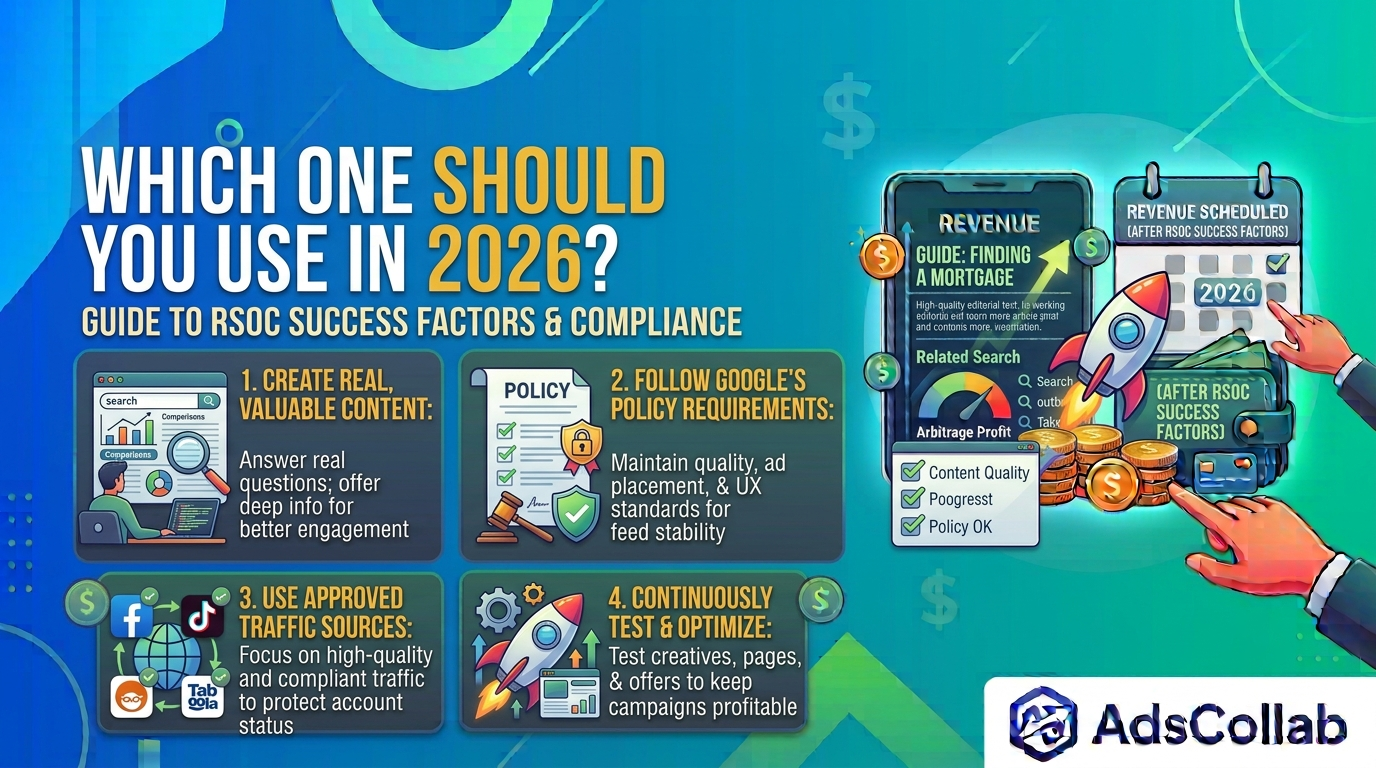
Since AFD is no longer available, RSOC is currently the main option for this type of search monetization. However, success with RSOC is not automatic. It depends on several important factors that determine whether the model can perform well over the long term.
- Creating real, valuable content
RSOC works best when the landing page provides genuine value to the visitor. Pages that answer real questions, offer useful comparisons, or deliver clear information tend to generate better engagement and higher-quality clicks. Thin or low-effort content usually leads to weaker performance and higher compliance risk.
- Following Google’s policy requirements
Google maintains strict standards for RSOC pages. This includes rules around content quality, ad placement, user experience, and traffic sources. Publishers who carefully follow these policies are more likely to maintain stable access to the feed and avoid sudden restrictions.
- Using approved traffic sources
Not every traffic source is suitable for RSOC. Using non-compliant or low-quality traffic can negatively affect account standing and feed performance. Focusing on approved and higher-quality traffic sources helps protect long-term results.
- Continuously testing and optimizing
RSOC is a performance-driven model. Successful operators regularly test different creatives, landing pages, traffic sources, and offers. Continuous optimization is essential to maintain profitability as costs, competition, and platform rules change over time.
Final Thoughts
The biggest difference between RSOC and AFD is simple:
AFD relied on domains with little content, while RSOC relies on real content pages with embedded related-search units.
With AFD officially discontinued, RSOC has become the standard model for publishers and media buyers who want to monetize search intent through content. For more guides on RSOC, search monetization, and related strategies, you can visit adscollab.com.
Do you still have questions about the difference between RSOC and AFD? Leave a comment below!

