Why is my AdSense RPM low? This is one of the most frequent questions publishers ask in 2026. Even with decent traffic, many websites struggle with low RPM (Revenue Per Mille). If your earnings per thousand impressions are disappointing, you’re not alone. This guide explores the most common reasons for low AdSense RPM and provides practical solutions to improve it.
What Is a Good AdSense RPM in 2026?
Before jumping into solutions to fix your low AdSense RPM, it’s crucial to understand what constitutes a normal or good benchmark in today’s market. Revenue performance can vary greatly depending on your niche, audience location, and content type. Knowing these numbers helps you set realistic expectations and quickly identify whether your current RPM is truly underperforming or simply typical for your situation.
- Average AdSense RPM usually falls between $6 and $8. This is the typical range for most websites, especially those in general content or lower-competition niches. Many new or medium-sized publishers often see their RPM sitting within this range.
- A good RPM is generally considered to be between $8 and $15. Reaching this level shows that your site has decent traffic quality and optimization. Websites in moderately competitive niches or with good user engagement often achieve this benchmark.
- An excellent RPM ranges from $15 to $30 or even higher, particularly in high-intent niches such as finance, insurance, legal services, or B2B. Only well-optimized sites with strong commercial intent traffic and premium ad setups can consistently hit these numbers.
If your RPM is consistently below $5–$6, there is likely significant room for improvement. This low performance usually indicates issues with niche selection, traffic quality, ad placement, or technical optimization that should be addressed.
8 Common Reasons Why Your AdSense RPM Is Low
Low AdSense RPM is a frustrating problem that many publishers face, even with decent traffic. The good news is that most causes are fixable once you identify them. Below are the 8 most common reasons for low RPM in 2026, along with practical solutions to help you improve your earnings.
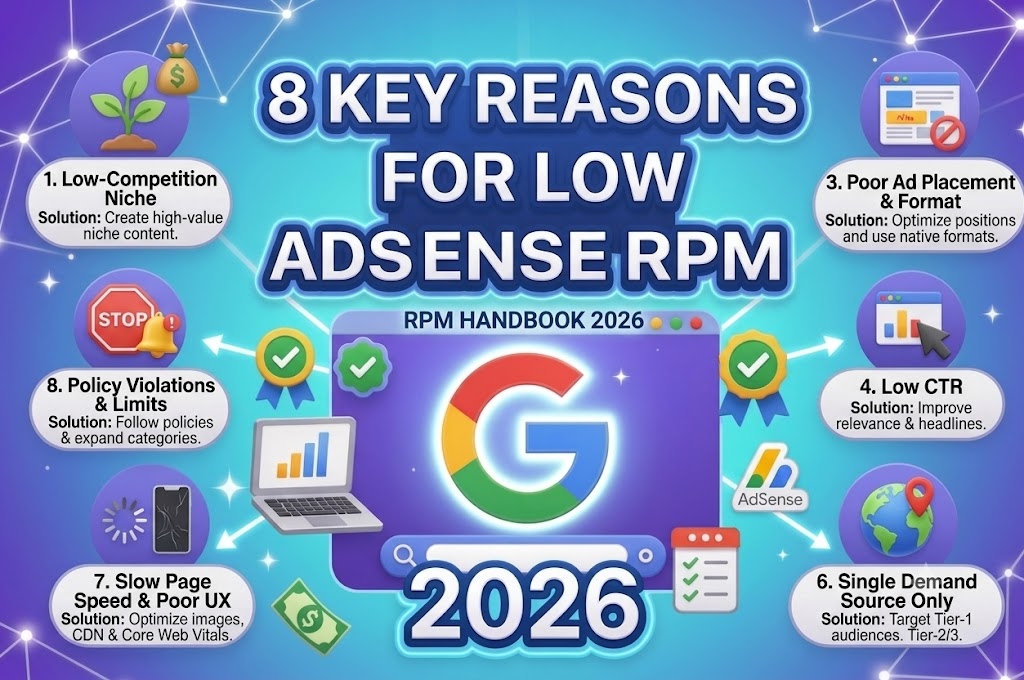
1. Low-Competition Niche
Content in entertainment, lifestyle, or general news usually has much lower RPM compared to finance, insurance, legal, or B2B niches. Advertisers in high-value industries are willing to pay more.
Solution: Consider creating more content in high-CPM verticals or adding comparison/review articles that attract commercial intent.
2. Poor Traffic Quality & Low User Intent
If most of your traffic comes from social media, browse traffic, or low-intent users, advertisers pay less. High RPM requires users who are actively researching or ready to buy.
Solution: Focus on SEO for transactional and commercial keywords. Improve content to better match user search intent.
3. Suboptimal Ad Placement and Format
Bad ad placement (too many ads, intrusive formats, or poor positioning) leads to low CTR and lower RPM. Google also penalizes sites with bad user experience.
Solution: Test different ad layouts using heatmaps. Prioritize above-the-fold but non-intrusive placements. Use responsive and native ad formats.
4. Low CTR (Click-Through Rate)
Even with good traffic, if users rarely click on ads, your RPM will suffer.
Solution: Improve ad relevance by matching content topics with ad themes. Use attractive headlines and test different ad sizes and colors.
5. Geographic Location of Audience
Traffic from Tier-2 and Tier-3 countries typically has much lower RPM than traffic from the US, UK, Canada, or Australia.
Solution: Create content that appeals to Tier-1 audiences and consider geo-targeting strategies if possible.
6. Not Using Header Bidding or Multiple Demand Sources
Relying only on AdSense (single demand source) often results in lower competition and lower fill rates.
Solution: Implement header bidding or use platforms like Ezoic, Setupad, or Publift to increase competition for your ad inventory.
7. Slow Site Speed & Poor User Experience
Slow loading times and bad mobile experience reduce both user engagement and AdSense performance.
Solution: Optimize images, enable caching, use a good CDN, and improve Core Web Vitals.
8. Policy Violations or Limited Ad Approval
Frequent policy violations or limited ad categories approved by Google can severely restrict revenue.
Solution: Review and strictly follow AdSense policies. Diversify with other ad networks to reduce risk.
Quick Action Plan to Boost Your AdSense RPM
Improving your AdSense RPM doesn’t have to be complicated. By focusing on a few high-impact actions, you can start seeing positive results within weeks. Here is a practical, step-by-step action plan that many publishers have successfully used to increase their earnings:
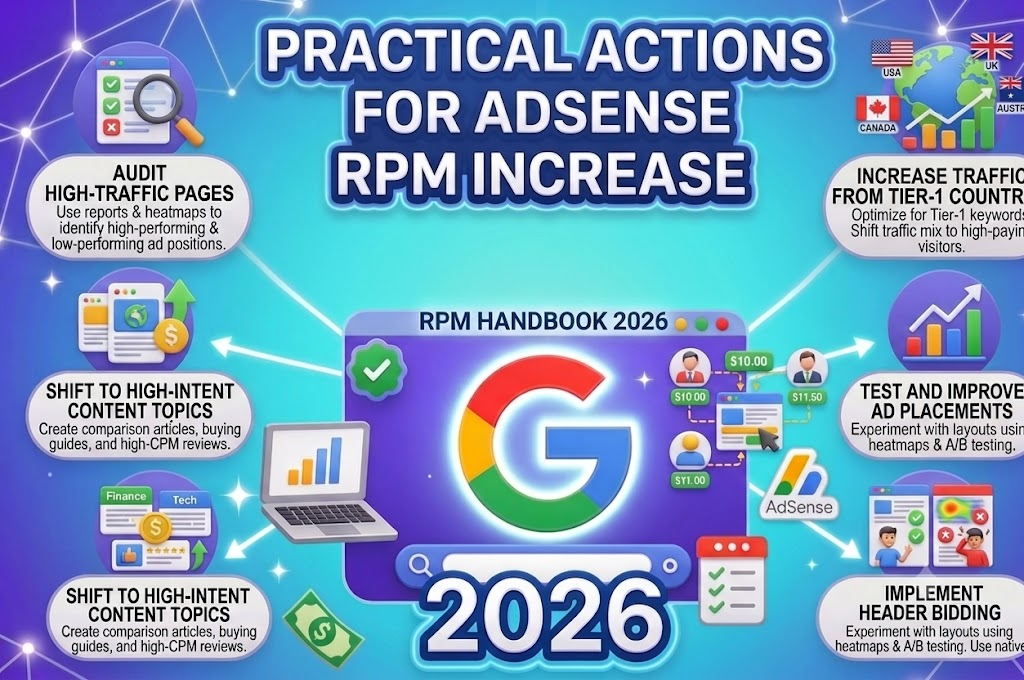
• Audit your top 10 pages for ad performance
Start by analyzing your top 10 highest-traffic pages to see how ads are performing. Use AdSense reports or heatmapping tools to identify which ad placements get the most clicks and which ones are being ignored. This audit helps you understand what is working and what needs improvement on your most important pages.
• Switch to high-intent content topics
One of the fastest ways to raise RPM is to shift your content strategy toward high-intent topics. Focus on creating more comparison articles, buying guides, “best of” lists, and review content in competitive niches like finance, insurance, legal, or technology. These topics attract users with strong commercial intent, leading to higher advertiser bids and better overall earnings.
• Implement header bidding or an optimization platform
Relying only on standard AdSense often limits competition for your ad inventory. Implementing header bidding or using an optimization platform like Ezoic, Setupad, or Publift allows multiple advertisers to bid on your space in real time. This increased competition usually results in higher fill rates and significantly better RPM.
• Test and improve ad placements
Poor ad placement is a common cause of low RPM. Experiment with different layouts using heatmaps and A/B testing. Prioritize high-visibility but non-intrusive positions such as above the fold and within content. Using responsive and native ad formats that blend well with your design can also improve user experience and click rates.
• Focus on increasing traffic from Tier-1 countries
Traffic from the United States, United Kingdom, Canada, and Australia typically pays much higher RPMs than traffic from Tier-2 and Tier-3 countries. Create content that appeals to these audiences, optimize for keywords popular in those regions, and use geo-targeting strategies in your promotion efforts to gradually shift your traffic mix toward higher-paying visitors.
Final Thoughts
Low AdSense RPM is rarely caused by just one factor. Most publishers see significant improvement after addressing 2–3 key issues above. In 2026, the publishers who succeed are those who treat AdSense as part of a diversified strategy rather than their only source of income.
If your RPM is still low after optimization, it might be time to explore premium networks or hybrid solutions.
Would you like help auditing your site or building a custom monetization strategy? Feel free to reach out to the AdsCollab team.

