The search monetization landscape has undergone a complete transformation in 2026. For years, publishers, domain owners, and arbitrage marketers relied on AdSense for Domains (AFD) as the default monetization channel - a system that allowed virtually any parked page or domain to generate revenue without original content. That era is officially over.
AFD shut down on February 10, 2026.
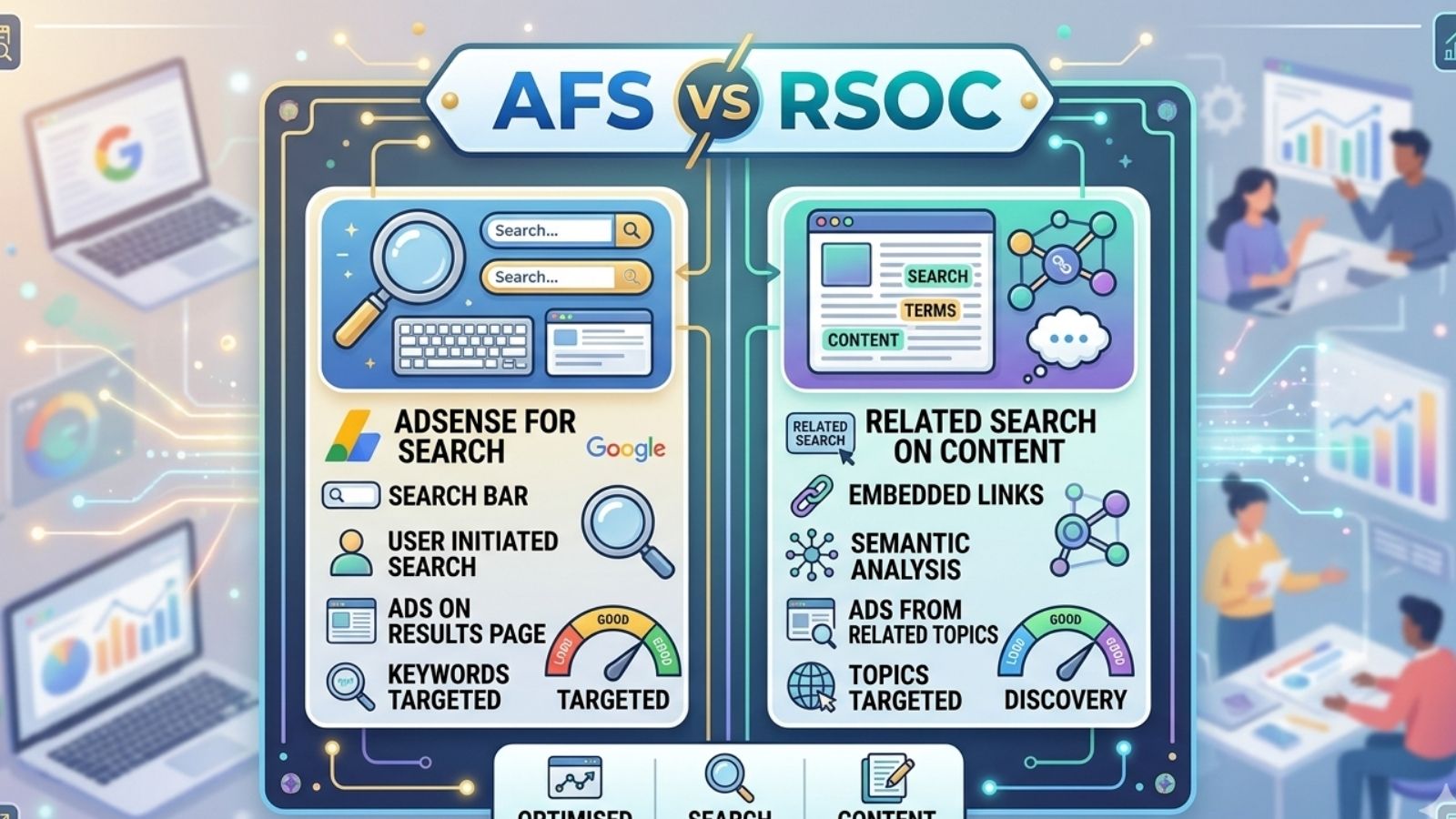
What replaced it - and what is now at the center of every serious publisher's monetization strategy - is the AFS vs RSOC question. AdSense for Search (AFS) and Related Search on Content (RSOC) are now the two critical pillars of Google's search-based monetization ecosystem. Understanding how they differ, how they interact, and which setup drives better revenue is no longer optional for publishers who want to survive and grow.
This guide gives you the full picture: what AFS and RSOC actually are, how they compare across every key metric, what Google's 2025–2026 policy changes mean for your setup, and how to build a monetization strategy that remains compliant and profitable in 2026 and beyond.
What Is AFS (AdSense for Search)?
.jpg)
AdSense for Search (AFS) is Google's publisher product that enables websites to embed a Google-powered search box directly on their pages. When visitors use that search box and click on the resulting sponsored ads, the publisher earns a share of the revenue.
AFS has been available to publishers for over a decade, but in 2026 it operates under significantly stricter access controls than it did even two years ago. Publishers who want full AFS functionality - including advanced customization, partner-provided keywords, and granular reporting - must now qualify for Restricted Access Features (RAFs), a premium tier introduced by Google effective August 25, 2025.
Core AFS characteristics:
- Embeds a live Google search box into publisher websites
- Revenue generated when users search and click on sponsored results
- Publisher receives 51% of the revenue from AFS-generated ad clicks (versus 68% for display AdSense)
- Requires a valid AdSense account and formal AFS activation with accepted terms of service
- Full functionality (RAF-enabled) requires passing Google's eligibility and policy standards
- Non-RAF access limits publishers to 5 or fewer search term suggestions, no partner keywords, and basic reporting only
AFS is the infrastructure layer. RSOC is one of the most powerful monetization formats built on top of that infrastructure.
What Is RSOC (Related Search on Content)?
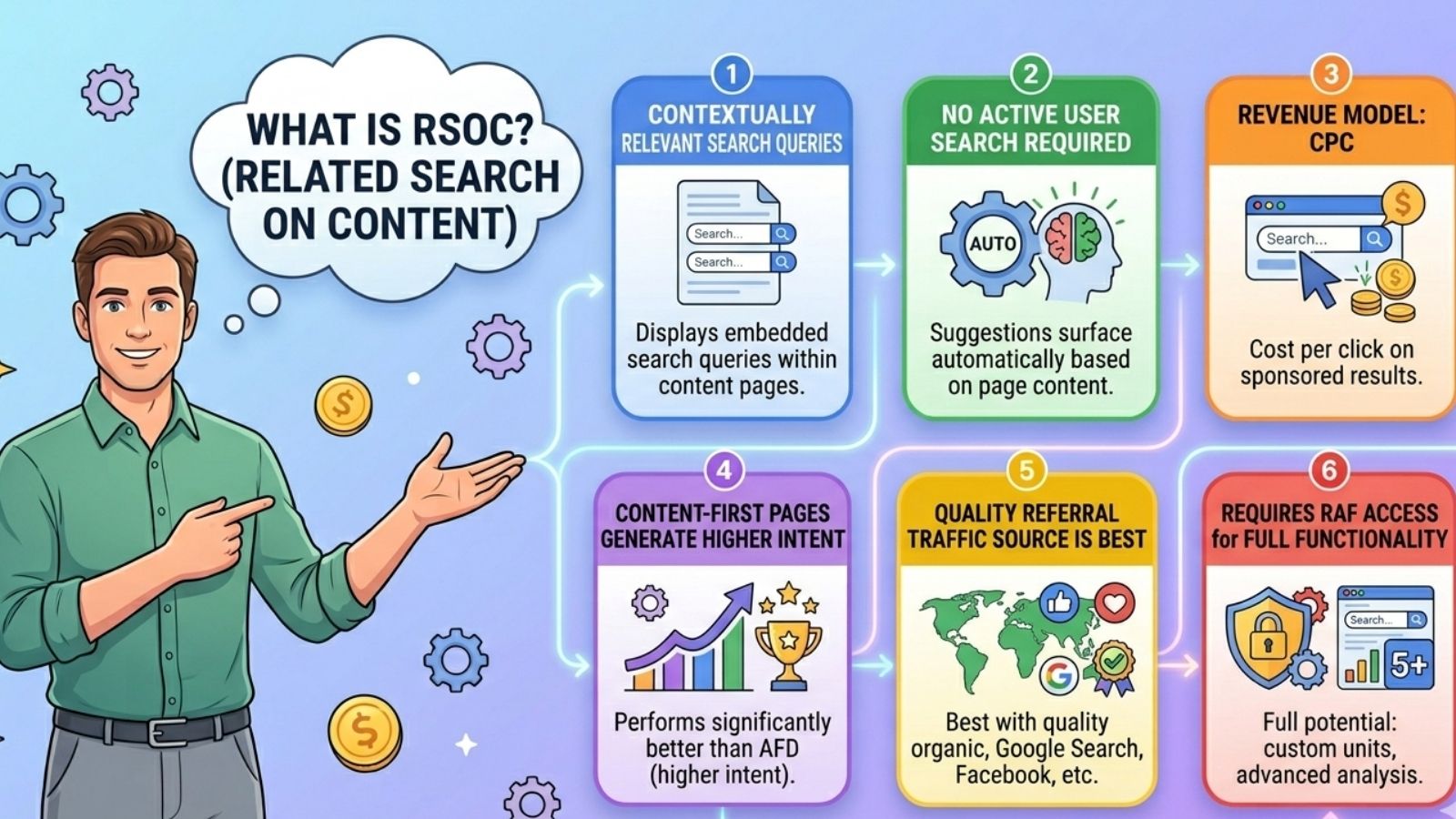
RSOC - Related Search on Content - is a monetization format that lives within the AFS ecosystem. Rather than a standalone search box requiring user input, RSOC automatically surfaces contextually relevant search terms directly within the content of a webpage - typically appearing near the top of an article, just after the introduction, or in-line with the main body.
When a visitor clicks one of these suggested related search terms, they are directed to a search results page featuring sponsored ads. The publisher earns revenue from those ad clicks on a cost-per-click (CPC) basis.
RSOC is an ad unit in the AFS ecosystem that contains related search terms similar to those found on an AFD lander, but unlike AFD, it lives within a page of content and derives its suggestions from that content.
Core RSOC characteristics:
- Displays contextually relevant search queries embedded within content pages
- No active user search required - suggestions surface automatically based on page content
- Revenue model: CPC (cost per click) on sponsored results
- Performs significantly better than AFD because content-first pages generate higher advertiser intent
- Works best with organic traffic from Google Search, Facebook, or other quality referral sources
- Requires RAF access for full functionality: custom units, more than 5 queries, advanced analytics
Compared to AFD, RSOC's content-first approach offers broader applicability and improved engagement. It can precisely target a wide range of traffic types, and because the ads are highly relevant to the user's search, they often lead to better click-through results.
AFS vs RSOC: Full Side-by-Side Comparison (2026)
| Feature | AFS (Standard Search Box) | RSOC (Related Search on Content) |
|---|---|---|
| Format | Embedded search box requiring user input | Auto-displayed related search terms within content |
| User Action Required | Yes - user must type a query | No - suggestions display automatically |
| Revenue Trigger | User searches + clicks sponsored result | User clicks a displayed related search term |
| Best Traffic Type | Users with active search intent | Organic, content-driven, and paid traffic |
| Content Requirement | Search box can sit on any page | Requires genuine, quality content page |
| Revenue Share (Publisher) | 51% of AFS-generated clicks | 51% of AFS-generated clicks (same pool) |
| RAF Required for Full Access | Yes (since Aug 25, 2025) | Yes (since Aug 25, 2025) |
| Max Search Suggestions (non-RAF) | 5 only | 5 only |
| Max Search Suggestions (RAF) | Partner-provided + unlimited | Partner-provided + unlimited |
| Reporting Depth | Up to 500 channels (RAF) | Up to 500 channels; upgradeable to 100,000 |
| Compliance Risk | Moderate | Higher - strict content quality requirements |
| Scalability | Moderate | High - scales across content site networks |
| Best For | Sites with a natural search use case | Content publishers, search arbitrage, domain traffic |
| AFD Replacement | Partial replacement | Primary replacement in 2026 |
The AFS–RSOC Relationship: How They Work Together
A common source of confusion is treating AFS and RSOC as competing products. They are not. RSOC is a format that runs on top of the AFS platform. Understanding this relationship is fundamental to building a successful monetization strategy.
Here is how the complete ecosystem works in 2026:
AFS is the underlying Google product - the contractual framework, the ad serving infrastructure, and the revenue attribution system. When you activate AFS in your Google AdSense account, you gain access to the tools and ad serving capabilities that make search-based monetization possible.
RSOC is one implementation of those tools - specifically, the format in which related search terms are displayed contextually within content rather than requiring user-initiated search input.
When a publisher implements RSOC on their content pages, they are using the AFS ad serving system to deliver and monetize those related search units. The revenue flows through the same AFS pipeline, and the same RAF policy framework governs access to advanced features.
Think of it this way: AFS is the engine. RSOC is one of the most effective vehicles built around that engine.
What Changed in 2025–2026: The Policy Landscape
The RAF Update (August 25, 2025)
From August 25, 2025, advanced tools used in AdSense for Search became restricted, available only to publishers who pass new eligibility and policy standards.
These are premium tools Google provides to publishers who consistently play by the rules. They include: Custom Related Search Units with more than 5 search term suggestions including partner-provided ones; Styling Control to tweak font, size, icons, and layout; and Advanced Reporting with access to 500+ channels, block ID tracking, and click-position level data.
Publishers without RAF access face a significantly degraded experience: limited to 5 suggestions, no partner keywords, no multiple search units per page, and minimal optimization data. Some publishers might see a 30–60% drop in earnings without RAFs.
The AFD Shutdown (February 10, 2026)
With AFD shutting down in February 2026, the race to master Related Search on Content is well and truly on, as RSOC allows domains to access the full spectrum of advertisers using Google Search results.
Google's policy changes for AdSense for Domains resulted in a 60% drop in revenue, and policy changes that automatically opted out advertisers' ads from showing on Google-based parked pages resulted in a 95% drop, followed by the announcement of the inevitable shutdown of AFD in February 2026.
The 3-Strike Enforcement System
Google introduced a strike-based system for AFS/RSOC policy violations in 2025 that remains fully enforced in 2026:
- 1st Strike: 90-day probation period
- 2nd Strike: 90-day feature restriction
- 3rd Strike: Permanent ban from RAF access
This system fundamentally changed how publishers must approach RSOC compliance. One policy violation by a media buyer, content writer, or developer can now put the entire account at risk.
Revenue Potential: AFS vs RSOC in Practice
How Revenue Is Generated
Both AFS and RSOC generate revenue through the same fundamental mechanism - a user clicks a sponsored search result, and the publisher receives 51% of the revenue Google collects from that click. The meaningful difference lies in how that click is triggered and how efficiently the format drives qualified clicks.
- Standard AFS (search box only): Revenue depends entirely on users proactively using the embedded search box. In content-heavy environments, this passive format typically generates lower engagement.
- RSOC: Revenue is driven by contextually surfaced search suggestions that appear naturally within content. Because the suggestions match the page topic and the user's interest, click rates are meaningfully higher.
RPM Benchmarks by Setup (2026 Data)
| Setup | Estimated RPM Range | Notes |
|---|---|---|
| AFS Search Box Only | $2 – $8 | Depends heavily on search volume and niche |
| RSOC (Non-RAF, basic) | $5 – $15 | Limited to 5 suggestions, reduced optimization |
| RSOC (RAF-enabled, optimized) | $15 – $40+ | Full customization, partner keywords, A/B testing |
| RSOC + Multi-Feed Stack | $20 – $50+ | Top-performing publishers with multi-partner setups |
High-value niches - finance, insurance, legal, real estate - consistently push RSOC RPM toward the upper range of these benchmarks. Geography also plays a major role: US and UK traffic commands significantly higher CPCs than most other markets.
The Revenue Architecture in 2026
A modern stack runs at least two search feeds plus a secondary rail (affiliate, commerce CPC, or native) behind the same RSOC compliance template. Rotations, RPM floors, and automatic failover smooth bad hours or partner hiccups.
Top-performing publishers in 2026 are not relying solely on AFS or a single RSOC implementation. The winning architecture combines:
- Primary RSOC feed via RAF-enabled AFS
- Secondary search feed from a partner provider (System1, Ads.com, Sedo, or similar)
- Tertiary monetization rail via affiliate offers, lead generation, or native ads
This multi-feed approach protects revenue against single-source policy issues, traffic fluctuations, or partner-level downtime - a lesson many publishers learned the hard way during the January 2026 Google infrastructure disruptions.
Step-by-Step: How to Set Up AFS and RSOC in 2026
Step 1: Ensure Your AdSense Account Is Active and Policy-Clean Before activating AFS, your main AdSense account must be in good standing. Use the AdSense Policy Center to identify and resolve any outstanding violations. An account with active violations will not be approved for AFS or RAF access.
Step 2: Activate AdSense for Search (AFS) In your AdSense dashboard, navigate to the "AdSense for Search" section under monetization tools. Review and accept the AFS-specific terms of service - this is a separate contractual step from standard AdSense. Once accepted, AFS functionality becomes available in your account.
Step 3: Request RAF Access RAF access is not automatic. You must request it through your Google AdSense account manager. If you do not have a dedicated account manager, use the AdSense Help Center to submit an eligibility inquiry. Provide your account history, content quality evidence, and confirm your compliance posture. RAF access can take several weeks to be granted.
Step 4: Build Your Content Foundation RSOC requires genuine, high-quality content pages. Each page should have a clear topic, a minimum of 400–800 words of original content, and no misleading elements (fake urgency, deceptive navigation, or content that mismatches the ad topic). Google audits these pages as part of RAF eligibility and ongoing compliance.
Step 5: Create and Implement RSOC Units Once AFS is active and RAF access is granted, create RSOC units in your AdSense dashboard using Google's pre-built templates. Configure your placeholder zones, define keyword clusters that match your content topics, and implement the JavaScript snippet in your page header. With RAF, you can customize the unit's visual appearance, number of suggestions, and partner keyword sources.
Step 6: Configure Tracking and Reporting Set up channel tracking within AFS to track performance at the page level, device level, and geo level. If using a third-party tracking platform (ClickFlare, Voluum, etc.), integrate the AFS API for revenue attribution. This is essential for optimization - without granular data, you are flying blind.
Step 7: Monitor Compliance Weekly and Optimize Monthly Establish a weekly compliance review process. Check the AdSense Policy Center for any new flags. Review content pages against Google's quality standards. Monthly, analyze RPM by geo, device, and page to identify low performers and optimize cluster relevance for high performers.
Who Is Each Format Best For?
✅ Standard AFS (Search Box) Is Best For:
- Content sites where a search function is a natural part of the user experience (knowledge bases, recipe sites, how-to guides, Q&A platforms)
- Publishers whose users arrive with specific informational intent and actively seek additional content
- Sites that already have substantial organic traffic and established search behavior patterns
- Publishers who want to complement RSOC with a passive secondary revenue source on the same page
✅ RSOC Is Best For:
- Content publishers running search arbitrage - driving paid traffic to content pages and monetizing the post-click experience
- Domain portfolio operators migrating from AFD who now need content-based monetization
- Publishers building topic-specific content networks around high-value niches (finance, insurance, legal, real estate, health)
- Affiliate marketers looking to diversify beyond traditional offer-based monetization
- Any publisher targeting high-intent organic traffic in competitive verticals where advertiser CPCs justify content investment
Compliance in 2026: What You Must Get Right
Compliance is now the single biggest risk factor in AFS/RSOC monetization. The combination of RAF enforcement and Google's 3-strike system means that a single non-compliant page can cascade into account-wide restrictions.
Non-negotiable compliance requirements in 2026:
- Pages must deliver on what they promise in the headline - no bait-and-switch content
- Sponsored search results must be clearly labeled as "Sponsored Results"
- No manipulated clicks, fake engagement signals, or incentivized traffic
- No "pretend search" designs that mimic Google's UI without actual content
- Pages must load fast on mobile and comply with Core Web Vitals standards
- Content must be semantically relevant to the keyword clusters used in RSOC units
- No paid or incentive-based traffic directed to RSOC pages
Pages that promise what the headline says, label "Sponsored Results" clearly, load fast on mobile, and present semantically related choices don't just pass checks - they convert better.
Frequently Asked Questions (FAQ)
Q: Is RSOC the same as AFS? No. AFS (AdSense for Search) is Google's platform and infrastructure for search-based publisher monetization. RSOC (Related Search on Content) is a specific ad format that runs within the AFS ecosystem. RSOC displays contextual search suggestions automatically within content pages, whereas standard AFS requires an embedded search box with active user input.
Q: Do I need RAF access to run RSOC? You can run basic RSOC without RAF access, but you will be limited to 5 search term suggestions, no partner keywords, single search units per page, and minimal reporting. For any meaningful scale or optimization, RAF access is effectively required. Without it, publishers estimate revenue reductions of 30–60% versus RAF-enabled campaigns.
Q: How do I get RAF access in 2026? RAF access requires a request through your Google AdSense account manager. There is no self-serve application. You need an active, policy-compliant AdSense account, a history of quality content, and no outstanding strikes. The process typically takes several weeks.
Q: Can I use third-party RSOC feed providers instead of direct AFS? Yes. Feed providers like System1, Ads.com, Sedo, Inuvo, and others offer RSOC feeds without requiring direct AFS approval. These providers have their own approval processes and typically offer faster onboarding. The trade-off is that direct AFS integration generally offers higher payouts, while feed providers allow faster launches and lower compliance friction.
Q: What happened to AFD and why does it matter for AFS/RSOC? AdSense for Domains (AFD) - the original domain parking monetization product - was shut down by Google effective February 10, 2026. This shut down an entire monetization channel that many publishers had relied on for a decade, forcing a mass migration toward RSOC as the primary replacement. RSOC is now the dominant search-based monetization format for domain traffic, parked pages, and content arbitrage setups alike.
Q: Is paid traffic allowed with RSOC? It depends entirely on the source and the setup. Organic traffic is always preferred and carries no compliance risk. Paid traffic from quality sources (Google Ads, Meta, native networks) is used by many RSOC publishers, but must be disclosed and must generate genuine user engagement - not forced or incentivized clicks. Incentive-based traffic directed at RSOC pages is explicitly prohibited and is a common cause of RAF violations.
Final Verdict: AFS vs RSOC in 2026
The AFS vs RSOC comparison in 2026 is not really a competition between two opposing options - it is a question of implementation depth. AFS is the platform; RSOC is the highest-performing format on that platform. The most successful publishers in 2026 are using both together, with RAF-enabled RSOC as their primary revenue driver and standard AFS search integration as a secondary engagement and revenue layer.
What defines success in this environment is no longer just traffic volume or click rates. It is the combination of content quality, compliance discipline, and monetization architecture. Publishers who build genuine content, maintain clean accounts, and diversify across multiple feed sources are capturing the revenue that less disciplined competitors are losing to strikes and restrictions.
The AFD shutdown removed a massive pool of low-quality competition. For publishers who adapt correctly, that creates real opportunity. RSOC, implemented properly under a RAF-enabled AFS account, represents one of the highest-yield monetization formats available to content publishers in 2026.
For more practical strategies on search monetization, ad revenue optimization, and publisher tools, visit Our blog - a comprehensive resource for publishers navigating the evolving programmatic landscape.
If you’re building or scaling a content monetization strategy in 2026 and want to understand how RSOC works alongside display advertising and other revenue streams, the publisher resources on AdsCollab provide practical frameworks to help you maximize total revenue per visitor across multiple channels.
👉 Ready to boost your monetization performance? Contact Us for expert support and tailored solutions.

