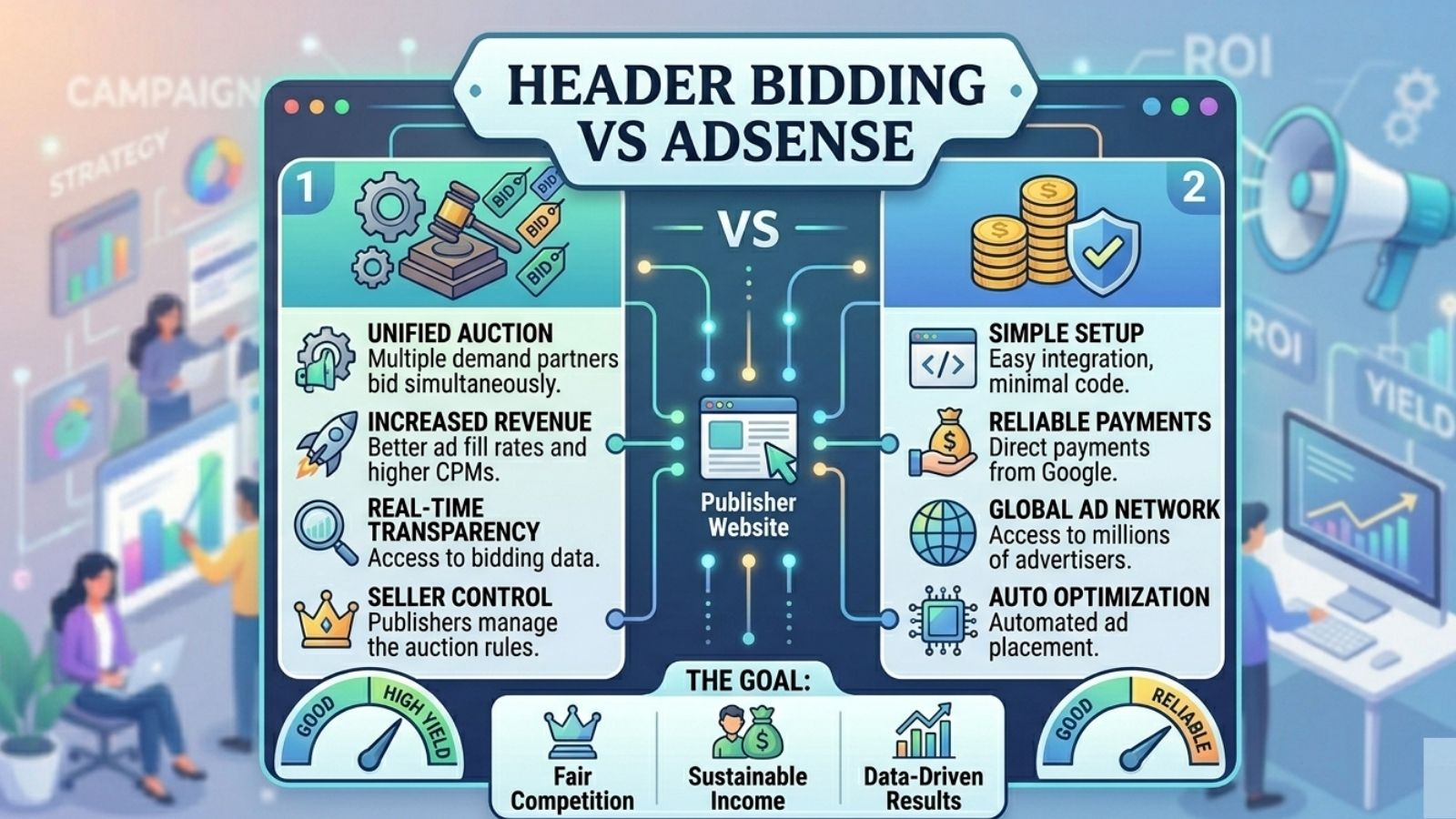
Every publisher eventually hits the same wall: your traffic is growing, your content is solid, but your AdSense revenue has flatlined. The RPM stays stubbornly between $3 and $8 no matter how much you optimize. Sound familiar?
The answer most high-earning publishers have already discovered is header bidding - an advanced ad auction technology that fundamentally changes how your ad inventory is sold. While Google AdSense runs a single, closed auction from one demand pool, header bidding opens your inventory to a simultaneous real-time auction across dozens of demand sources, forcing advertisers to compete and driving your CPMs significantly higher.
In 2026, with global programmatic ad spending projected to reach $786 billion and climbing toward $800 billion by 2028, the gap between publishers using AdSense alone and those leveraging header bidding has never been wider. This guide breaks down everything you need to know - how each system works, how they compare, and how to decide which approach fits your website right now.
What Is Google AdSense? (And Why Publishers Outgrow It)
.jpg)
Google AdSense is the world's most widely used ad monetization platform, trusted by over 40 million websites globally. It works by installing a simple code snippet on your website. Once live, Google's system automatically serves contextual ads based on your content and your visitors' browsing history, then pays you per click (CPC) or per thousand impressions (CPM).
For new publishers, AdSense is the perfect starting point. It's free, beginner-friendly, requires minimal technical knowledge, and is backed by Google's enormous advertiser base.
But here's AdSense's fundamental limitation: it operates as a closed, single-source auction. When your page loads, AdSense contacts only Google's own ad network to fill that impression. There is no competition from external demand sources. No Amazon. No Rubicon. No OpenX. Just Google - bidding against itself.
This structural limitation creates a revenue ceiling. Most publishers find that:
- AdSense RPM typically plateaus between $3–$10 regardless of traffic growth
- Revenue per session stagnates even as pageviews increase
- Publishers have no visibility into what other advertisers might have paid
- There is no mechanism to create real bidding competition for your inventory
As one publisher described their experience after traffic grew from 20,000 to 50,000 monthly visits: "AdSense RPM stayed stuck between $5–$8. It's like having fertile land but planting only one crop."
What Is Header Bidding?
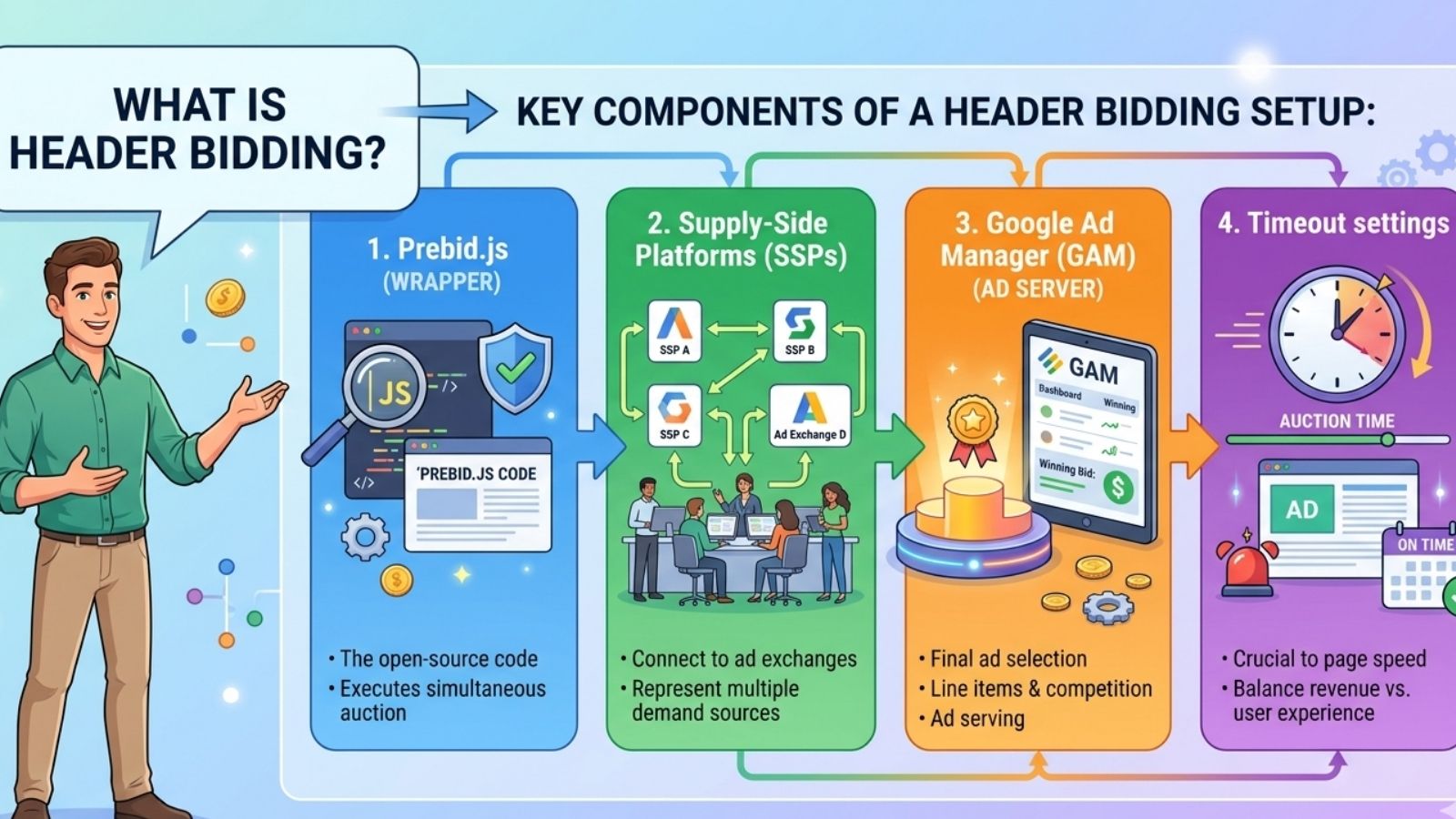
Header bidding - also called advance bidding or pre-bidding - is a programmatic advertising technology that allows publishers to offer their ad inventory to multiple demand partners simultaneously before making any call to their ad server.
The technology gets its name from where the bidding code lives: in the header section of a web page, so the auction fires before the page content even fully loads. This strategic placement ensures that every potential buyer - Google AdX, Amazon, Rubicon, OpenX, and others - has an equal, simultaneous opportunity to bid on every impression.
The result is a genuine, competitive marketplace where the highest bidder always wins, rather than the first bidder that meets a price floor.
Key components of a header bidding setup:
- Prebid.js - The most widely used open-source header bidding wrapper, managing bid requests to multiple demand partners
- Supply-Side Platforms (SSPs) - Technology platforms that connect publisher inventory to ad buyers (e.g., Google AdX, Rubicon, OpenX)
- Google Ad Manager (GAM) - The ad server that receives all bids and renders the winning ad
- Timeout settings - Controls how long the auction waits for bids before defaulting to a floor price
As of early 2026, 70% of US online publishing websites have already adopted header bidding over traditional methods - a clear signal of where the industry has moved.
Header Bidding vs AdSense: How Each Auction Actually Works
Understanding the mechanics behind each system is crucial to understanding the revenue gap.
How AdSense Works (The Waterfall Model)
Before header bidding became mainstream, the industry relied on the waterfall model - a sequential, one-at-a-time approach to filling ad inventory.
- A user loads your page
- AdSense sends a request to Google's ad network
- Google's advertisers bid internally on the impression
- The winning ad is served
If Google's demand doesn't meet your floor price, the impression may go unfilled. At no point does any external demand source (Amazon, Rubicon, etc.) get a chance to bid - no matter how much they might have been willing to pay.
The waterfall's core flaw: Publishers often accept lower bids because higher-paying advertisers positioned outside Google's network never get a chance to compete. The sequence is based on Google's internal logic, not real-time market demand.
How Header Bidding Works (The Simultaneous Auction)
- A user loads your page
- A JavaScript wrapper in the page header instantly sends bid requests to all demand partners simultaneously
- Each partner (Google AdX, Amazon, Rubicon, OpenX, etc.) evaluates the impression and returns a bid in milliseconds
- The wrapper identifies the highest bid and passes it to Google Ad Manager
- GAM confirms the winner and renders the ad on your page
The entire process happens in milliseconds - invisible to the user, but enormously impactful to your revenue. Every impression goes to the highest bidder across all demand sources, not just Google's.
Header Bidding vs AdSense: Full Side-by-Side Comparison (2026)
| Feature | Google AdSense | Header Bidding |
|---|---|---|
| Auction Type | Single-source, closed | Simultaneous, multi-source |
| Demand Sources | Google Ads only | Google AdX, Amazon, Rubicon, OpenX, and 20+ more |
| Average RPM | $3 – $10 | $10 – $30+ |
| CPM Increase vs AdSense | Baseline | 20–70% higher on average |
| Setup Complexity | Very easy (code snippet) | Moderate to advanced (Prebid.js + GAM) |
| Ad Auction Transparency | Very limited | Full bid-level visibility |
| Price Floor Control | Minimal | Full control via GAM |
| Real-Time Bidding | No (Google controls timing) | Yes - true RTB across all partners |
| Ad Refresh Support | No | Yes |
| Analytics & Reporting | Basic | Granular (per-partner, per-placement data) |
| Revenue Predictability | Moderate | Higher, more stable with multiple sources |
| Technical Requirement | None | Requires Prebid.js or managed partner |
| Best For | Beginners, low-traffic sites | Growing publishers focused on revenue |
Revenue Impact: How Much More Does Header Bidding Pay?
RPM Benchmarks in 2026
The data across multiple sources and real publisher case studies in 2026 is consistent:
- AdSense RPM: $3 – $10 (most sites land between $5 and $8)
- Header Bidding RPM: $10 – $30+ depending on niche, geo, and optimization quality
Publishers implementing header bidding typically report CPM increases of 20–70% compared to AdSense alone, with some case studies showing results well beyond that range.
A real-world data point: A history content website that switched from AdSense to an Ezoic setup (which uses header bidding with Google AdX, Rubicon, and Amazon) saw monthly revenue increase from $7,764 to $27,005 - a 248% jump - with Page RPM improving from $5.81 to $19.60, despite a slight drop in sessions. The revenue improvement came entirely from better monetization, not more traffic.
Another benchmark: Services like Publisher Collective report their publishers earn an average of 57% more than AdSense alone, specifically attributing the gain to header bidding competition.
Why the gap is so large:
- When multiple demand sources compete simultaneously, advertisers are forced to bid higher to win
- Seasonal demand spikes (Q4 events like Black Friday and Christmas) generate dramatically more revenue when multiple bidders compete - AdSense, with no real competition, leaves this seasonal uplift largely uncaptured
- Header bidding also supports ad refresh, which regenerates revenue from long-session visitors - a feature AdSense does not offer
Step-by-Step: How to Implement Header Bidding on Your Site
Moving from AdSense to header bidding is a technical undertaking, but manageable with the right roadmap.
Step 1: Set Up Google Ad Manager (GAM) Header bidding requires a proper ad server. Sign up for Google Ad Manager (free for most publishers). GAM acts as the central hub that receives all bids and renders the winning ad.
Step 2: Choose Your Header Bidding Wrapper The most widely used option is Prebid.js - open-source, flexible, and community-maintained. It manages bid requests to all your demand partners and sends the highest bid to GAM. Alternatively, managed services (Ezoic, Setupad, MonetizeMore) handle Prebid configuration for you.
Step 3: Select Your Demand Partners (SSPs) Common SSPs integrated via Prebid.js include Google Ad Exchange (AdX), Amazon Publisher Services (APS), Rubicon (Magnite), OpenX, Index Exchange, and PubMatic. More competition means higher CPMs - but too many partners can slow page load times, so optimize carefully.
Step 4: Configure Line Items in Google Ad Manager Create price-tiered line items in GAM that represent Prebid bid ranges. This allows GAM to correctly compare header bidding bids against AdSense and other direct deals, serving whichever pays the most for each impression.
Step 5: Implement the Prebid Code in Your Header Place the Prebid.js wrapper code in the <head> section of your site. This ensures the auction fires before page content loads, minimizing latency impact.
Step 6: Set Timeout Values Configure bid timeouts (typically 1,000–3,000ms) to balance revenue against page speed. Too long and you hurt user experience; too short and you miss bids.
Step 7: Monitor, Adjust, and Optimize Use GAM's reporting alongside Prebid analytics to track which demand partners are winning, at what CPMs, and on which placements. Adjust floor prices and partner configurations monthly based on real data.
Who Is Each Approach Best For?
✅ Google AdSense Is Best For:
- New publishers with under 10,000 monthly page views who need a fast, friction-free start
- Websites where ad revenue is secondary to another primary business model (e-commerce, SaaS, etc.)
- Publishers with no technical resources for managing Prebid.js or GAM
- Sites that rely heavily on high click-through rates (CTR) in specific niches - in some edge cases, AdSense's CPC model can outperform impression-based header bidding if CTR consistently exceeds 1%
- Publishers who want to test monetization before committing to a more complex setup
✅ Header Bidding Is Best For:
- Content publishers with 50,000+ monthly page views where the revenue uplift justifies setup complexity
- Sites where display ads are the primary or significant revenue stream
- Publishers willing to invest in a technical setup (or use a managed service) in exchange for materially higher RPMs
- Websites with strong organic search traffic - header bidding platforms perform best with quality, engaged visitors
- Publishers looking to diversify away from a single demand source (especially after the AdSense revenue disruptions seen in January 2026, where some publishers reported 50–90% revenue drops due to Google infrastructure issues)
- Any site targeting Q4 seasonal revenue spikes - header bidding's competitive auction captures significantly more advertiser spend during peak periods
Pros and Cons: A Clear Summary
Google AdSense - Pros & Cons
Pros:
- Zero technical complexity - install and run
- No ad server setup required
- Great for building monetization history before upgrading
- Globally trusted with high fill rates
- Strong brand safety controls built in
Cons:
- Hard revenue ceiling regardless of traffic volume
- No external demand competition
- Impression-level opacity - you can't see competing bids
- No ad refresh support
- Revenue vulnerable to single-source infrastructure issues
Header Bidding - Pros & Cons
Pros:
- 20–70%+ higher CPMs from competitive auctions
- Access to premium demand: Google AdX, Amazon, and 20+ SSPs
- Full transparency into bid-level data
- Ad refresh capability for additional revenue per session
- Reduces dependency on any single demand source
- Adapts to real-time market conditions, not historical averages
Cons:
- Requires technical knowledge (Prebid.js, GAM configuration)
- More complex setup and ongoing management
- Can negatively impact page speed if not properly optimized
- Requires sufficient traffic to attract premium demand partners
- May need a managed service partner if you lack in-house ad ops expertise
Frequently Asked Questions (FAQ)
Q: Can I use AdSense and header bidding at the same time? Yes - and this is actually the recommended approach. Google AdSense can participate in a header bidding auction as one demand source. Through GAM, AdSense competes alongside other SSPs. If AdSense bids highest, it wins the impression. You don't lose your AdSense revenue; you simply add competition around it.
Q: Will header bidding slow down my website? It can, if not properly configured. The key is setting appropriate timeout values and limiting the number of demand partners to those that consistently deliver value. Server-side header bidding (as opposed to client-side Prebid.js) can also reduce latency significantly. When implemented correctly, the impact on Core Web Vitals is manageable.
Q: How much traffic do I need to implement header bidding? While technically there is no minimum, header bidding delivers the best return for publishers with 50,000+ monthly page views. Below that threshold, a managed platform like Ezoic (which handles Prebid integration for you) is often a better entry point. For very small sites, AdSense remains the most practical option.
Q: Is header bidding worth it for small publishers? Yes - but the implementation path matters. Small publishers should use a managed header bidding service (Ezoic, MonetizeMore, Setupad) rather than building a Prebid.js setup from scratch. These services provide header bidding access without requiring in-house ad ops expertise.
Q: What is Prebid.js? Prebid.js is the most widely used open-source header bidding wrapper. It manages bid requests to multiple SSPs simultaneously, collects all bids, identifies the highest, and passes it to Google Ad Manager. It's free to use and community-maintained, but does require technical implementation and ongoing configuration management.
Q: What happened to AdSense revenue in early 2026? In January 2026, many publishers using AdSense-only setups experienced significant revenue disruptions - some reporting 50–90% drops - due to Google Ad Manager infrastructure issues affecting coverage rates and demand sources simultaneously. Publishers with header bidding setups and multiple demand sources were significantly more resilient, as their revenue wasn't dependent on a single point of failure. This event reinforced the industry argument for demand diversification.
Final Verdict: Header Bidding vs AdSense in 2026
If your primary goal is simply to have ads on your site with minimal setup, AdSense is still a solid, legitimate choice. But if your goal is to maximize ad revenue from your existing traffic, header bidding is the clear winner in 2026 - and the data across hundreds of publisher case studies makes this conclusion hard to argue.
The core principle is straightforward: more competition for your ad inventory means higher prices. AdSense, by design, limits that competition to Google's own ecosystem. Header bidding removes that limitation.
The real question isn't whether header bidding pays more - it does. The question is whether your site has the traffic volume and technical resources to implement it effectively. For publishers who aren't quite ready to build their own Prebid setup, managed platforms provide a middle path: header bidding access without the full operational overhead.
For more in-depth guides on ad monetization strategies, programmatic advertising tools, and publisher revenue optimization, visit Our blog - a go-to resource for publishers serious about growing their ad earnings.
If you're also evaluating other monetization platforms alongside header bidding, contact us and let us help you map out the right upgrade path based on your traffic tier and revenue goals.

