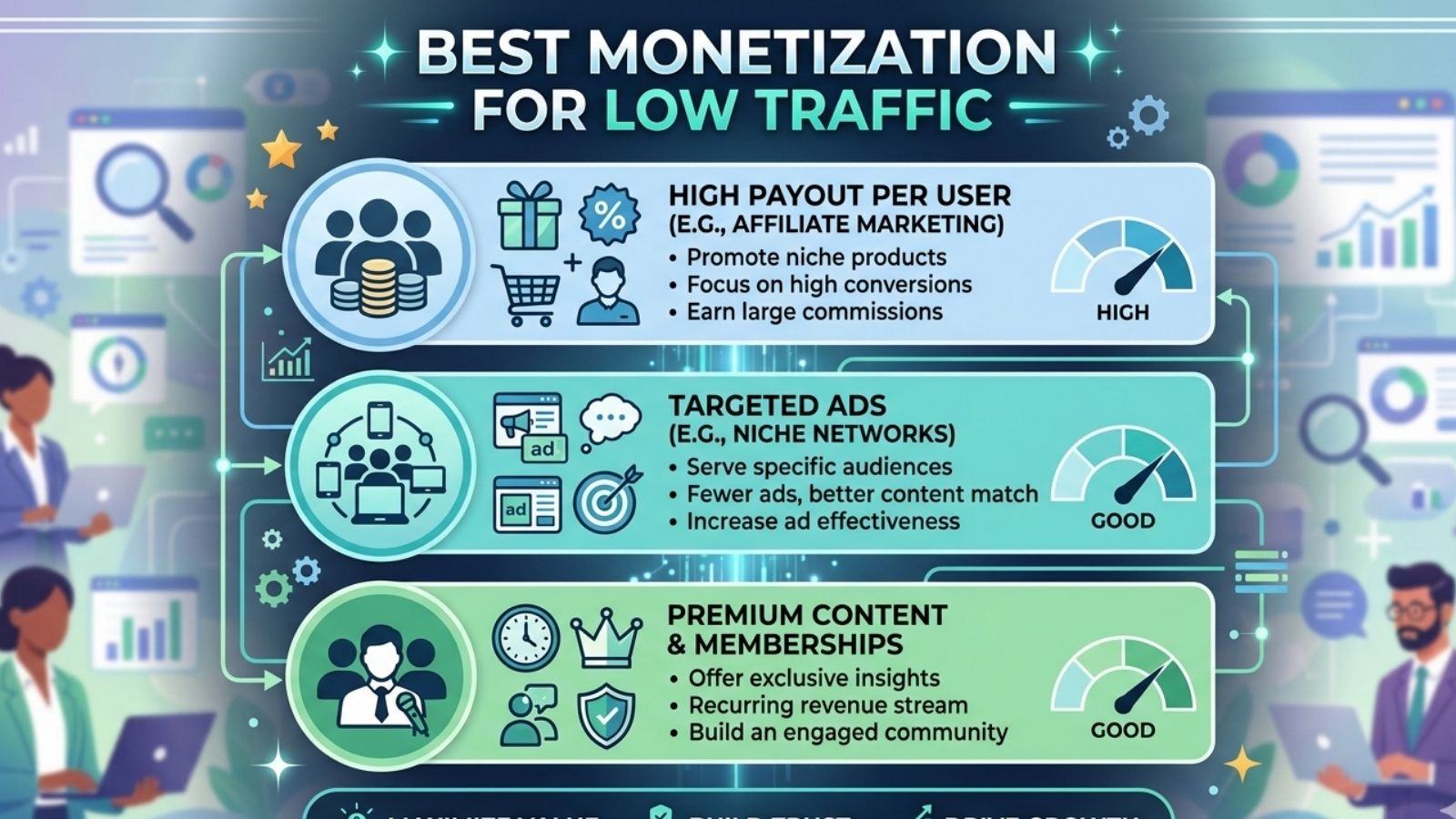
Here is the hard truth most beginner publishers eventually discover: display ads alone will not make you meaningful money with low traffic. If you are getting 1,000 to 10,000 monthly visitors, your Google AdSense earnings will likely sit between $3 and $30 per month - barely enough to cover hosting costs, let alone justify the effort you are putting into your content.
But low traffic does not mean zero income. Far from it.
In 2026, the smartest publishers are not chasing raw pageview numbers. They are building intent-based monetization stacks - combining strategies that reward the quality of their audience rather than the quantity. A focused site with 2,000 highly targeted monthly visitors can generate more revenue than a generic blog with 50,000 passive readers, when the right monetization approach is in place.
This guide covers the best monetization strategies for low traffic websites in 2026 - what actually works at every stage, how to combine methods for maximum return, and which tools and platforms give small publishers a real shot at sustainable income.
What "Low Traffic" Actually Means in 2026
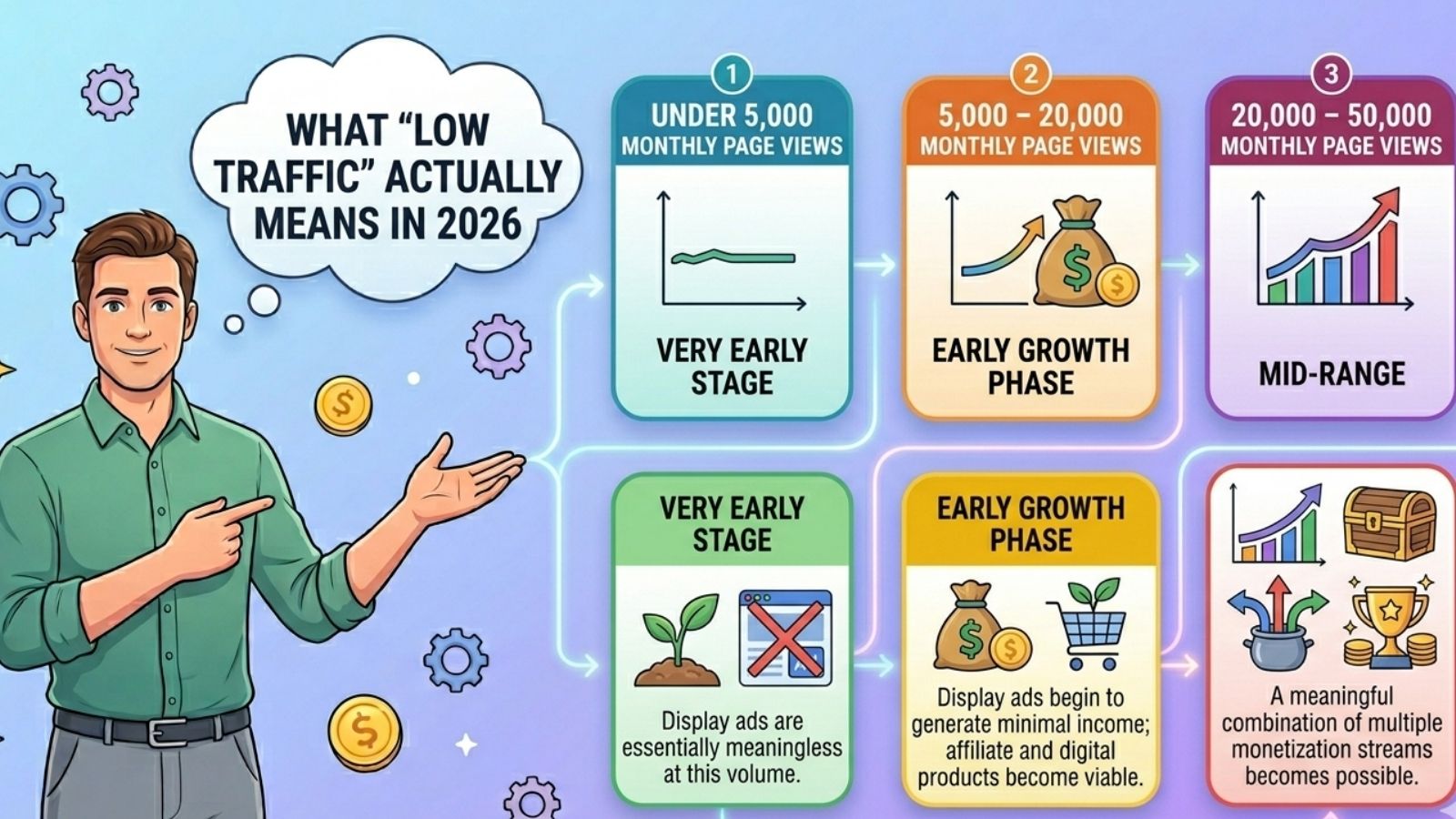
Before diving into strategies, it helps to define the starting point. Low traffic is generally considered to be:
- Under 5,000 monthly page views: Very early stage. Display ads are essentially meaningless at this volume.
- 5,000 – 20,000 monthly page views: Early growth phase. Display ads begin to generate minimal income; affiliate and digital products become viable.
- 20,000 – 50,000 monthly page views: Mid-range. A meaningful combination of multiple monetization streams becomes possible.
The threshold for "meaningful" display ad revenue is typically 10,000+ monthly pageviews for affiliate marketing and 10,000+ is ideal, while display advertising generally requires the same floor. Membership sites and digital products can be viable with as few as 500–1,000 highly engaged visitors.
The key insight for low-traffic publishers is this: move away from volume-dependent monetization and toward intent-dependent monetization. The strategies below are ordered by how well they perform at low traffic levels.
Strategy 1: Affiliate Marketing - The #1 Choice for Low Traffic Sites
Affiliate marketing is consistently the highest-returning monetization method for low-traffic publishers, and it is not particularly close. A small site that attracts 10 highly relevant clicks can generate more money than a big site sending thousands of random visitors to a generic ad network.
Here is why affiliate marketing outperforms display ads at low traffic:
- Revenue per action is dramatically higher. A single affiliate sale can generate $20 to $200+ in commission, versus $0.003 to $0.01 per pageview from display ads.
- No minimum traffic requirements. Amazon Associates, ShareASale, CJ Affiliate, and hundreds of niche programs accept publishers with very modest traffic.
- Works with highly targeted audiences. If your content attracts people who are actively researching a purchase decision, a well-placed affiliate link will convert.
Best affiliate programs for low-traffic sites in 2026:
- Amazon Associates - 1–10% commission, enormous product catalog, low conversion barrier
- ShareASale & CJ Affiliate - Access to thousands of niche programs with higher commission rates
- Impact.com - Strong SaaS and subscription programs (often $50–$200 per referred customer)
- PartnerStack - B2B software programs with recurring commissions
- Niche-specific programs - Often offer 20–40% commissions versus Amazon's 1–10%
Implementation tip: Focus on product reviews, comparison articles, and "best of" lists - content formats that target buyers in the final stages of their research. A reader searching for "best budget mechanical keyboard under $100" is far closer to purchasing than someone searching for "what is a mechanical keyboard."
Affiliate marketing can start with as few as 1,000 monthly visitors, making it the most accessible high-return monetization method for early-stage publishers.
Strategy 2: Digital Products - High Margin, No Traffic Floor
Selling digital products is arguably the most scalable monetization method for niche publishers. Unlike display ads, a single digital product sale can generate $9 to $197 or more from a single visitor - and you keep the majority of the revenue.
A $9 or $19 product that solves a very specific issue can convert surprisingly well when the traffic is targeted. On low-traffic sites, smaller, highly specific products consistently outperform broader offerings.
Digital products that work at low traffic volumes:
- PDF guides and ebooks - $9 to $49, low production cost, immediate delivery
- Templates and toolkits - Spreadsheets, Notion templates, Canva templates, code snippets
- Email courses - Drip-delivered educational sequences sold at $19 to $97
- Checklists and swipe files - Quick-win products priced at $5 to $29
- Mini courses - 1–3 hour video or written courses priced at $49 to $197
Key advantage for low-traffic sites: Digital products require no inventory, no shipping, and no minimum order quantity. Platforms like Gumroad, Lemon Squeezy, and Payhip allow you to start selling immediately with zero upfront cost.
The critical success factor is specificity. A guide titled "The Complete Beginner's Guide to Everything Marketing" will fail. A guide titled "The 5-Email Sequence That Books 3 Discovery Calls Per Week for Freelance Designers" will convert.
Strategy 3: Email List Monetization - Your Most Valuable Asset
Email lists are often treated as something you only worry about later, but they can still help with monetization early on. In practice, email list building from day one is one of the highest-leverage actions a low-traffic publisher can take.
Here is why: an email subscriber is worth exponentially more than a page view. A visitor who reads an article and leaves may never return. A subscriber who joins your list is a direct, repeatable revenue channel - completely independent of Google's algorithm, social media reach, or ad network policies.
How to monetize an email list at low traffic:
- Affiliate promotions: Send curated recommendations with affiliate links directly to your list. Conversion rates on email are typically 2–5x higher than website traffic.
- Digital product launches: A list of even 300–500 engaged subscribers can generate meaningful revenue from a well-timed product launch.
- Sponsored newsletter placements: Once your list reaches 1,000+ subscribers, brands in your niche will pay $50 to $500 per dedicated email placement.
- Paid newsletters: Platforms like Substack, Beehiiv, and Ghost allow you to gate premium content behind a subscription ($5 to $15/month per subscriber).
Tools to start building immediately: ConvertKit (now Kit), Beehiiv, and MailerLite all offer free tiers suitable for early-stage publishers. Place opt-in forms at the end of every article, within content, and as an exit-intent popup - with a clear lead magnet (a free guide, checklist, or template) as the incentive.
Strategy 4: Services and Consulting - The Fastest Path to Real Income
If your site is not attracting huge traffic, and you get just one to two paid enquiries each month, you can make more money than little banner ads ever could. Service-based monetization leverages the authority your content creates - converting readers into consulting clients, freelance customers, or coaching students.
This approach is particularly effective for sites covering professional topics: marketing, design, SEO, finance, legal, fitness, coaching, or any area where expertise commands a premium.
Service models that work at low traffic:
- Freelance services: Writing, design, development, SEO, social media management
- 1-on-1 consulting: Hourly or project-based consulting in your area of expertise
- Done-for-you services: Higher-priced packages where you deliver an outcome, not just advice
- Coaching programs: Structured 4–12 week programs at $500 to $5,000+
The traffic math is completely different here. If your site generates 2,000 monthly visitors and converts 0.1% to a $500 consulting inquiry, that is 2 clients per month and $1,000 in revenue - from traffic that would generate approximately $6 in AdSense income.
Add a clear "Work With Me" or "Hire Me" page to your site from day one. Many publishers with under 5,000 monthly visitors are generating $2,000 to $8,000 per month from services built around their content authority.
Strategy 5: Sponsored Content - Earlier Than You Think
Sponsored content is often dismissed as something that requires 50,000+ monthly visitors to attract brands. In reality, niche authority matters far more than raw traffic volume when it comes to sponsored content partnerships.
A site with 3,000 monthly visitors that exclusively covers a specific professional niche - cybersecurity tools for small businesses, for example - is more valuable to an advertiser in that space than a 30,000-visitor general tech blog.
How to attract sponsors at low traffic:
- Build a simple media kit (one-page PDF) outlining your audience demographics, content niche, monthly visitors, and email list size
- Proactively reach out to brands that already advertise in your niche via other channels
- Join sponsored content networks: AspireIQ, Cooperatize, Activate (previously Bloglovin), or Izea
- Offer "founding sponsor" rates to early partners - discounted in exchange for longer commitments
Pricing guidance for low-traffic sponsored content:
- 1,000–5,000 monthly visitors: $50–$200 per sponsored post
- 5,000–15,000 monthly visitors: $150–$500 per sponsored post
- Niche authority premium: Add 25–50% for highly targeted professional audiences
Strategy 6: Display Ads - Use Smartly, Not as Your Primary Strategy
Display advertising is the default recommendation for website monetization - and for low-traffic sites, it is also the most overrated. At under 10,000 monthly page views, display ad revenue is minimal regardless of which network you use.
That said, display ads have a place in a diversified low-traffic strategy, particularly because they are completely passive once implemented. Here is how to use them intelligently:
Ad networks accessible at low traffic (2026):
- Google AdSense - No strict traffic minimum; approval based on content quality. RPM of $2–$8 for general niches, up to $20–$30 for finance, legal, or insurance content.
- Ezoic (Access Now program) - No traffic minimum; AI-optimized placements can meaningfully increase RPM versus AdSense alone.
- Monetag - No traffic minimum; useful as a secondary network alongside AdSense for backfill.
- Media.net - Requires at least 5,000 monthly visitors; higher CPMs for US and UK traffic.
- Adsterra - Accepts publishers regardless of traffic volume; useful for international or mixed-geo traffic.
Ad placement strategy for low-traffic sites:
- Focus on high-viewability placements: sticky sidebar and in-content after the second paragraph
- Mobile-first optimization is non-negotiable - over 70% of traffic in 2026 arrives from mobile devices
- Avoid excessive ad density - it harms SEO and user experience, especially damaging for small sites still building authority
The niche premium is real: Publishers in finance, insurance, legal, and real estate consistently see RPMs of $15–$30 even at low traffic, because advertiser CPCs in these verticals are dramatically higher than general categories. Writing about "luxury watches" or "financial planning" will generate significantly more ad revenue than "daily vlogs" from the same volume of traffic.
Strategy 7: Memberships and Subscriptions - For Loyal Niche Audiences
Membership monetization is viable at surprisingly low traffic levels - as few as 500 to 1,000 highly engaged visitors - when the content delivers specific, ongoing value that a targeted audience cannot easily find elsewhere.
The increasing use of subscription models is one of the notable trends in website monetization for 2026. More websites are providing exclusive, premium content behind a paywall, creating a consistent source of revenue through recurring fees.
Membership models for low-traffic sites:
- Paid newsletter: $5–$15/month via Substack, Beehiiv, or Ghost. Even 50 paying subscribers at $10/month generates $500 in recurring monthly revenue.
- Community membership: $20–$50/month for access to a private forum, Slack group, or Discord server with regular Q&A or expert access.
- Content library access: $9–$29/month for a growing archive of premium articles, templates, or resources.
- Mastermind groups: $100–$500/month for small, high-touch peer groups in professional niches.
Platforms: Substack, Ghost, Memberful, Patreon, and Circle are all optimized for content-based membership businesses and require no technical development to launch.
Strategy 8: Lead Generation - Sell Qualified Leads, Not Ad Clicks
Lead generation is one of the least discussed but most lucrative monetization models for niche content sites with low traffic. Rather than earning $0.005 per pageview from an ad network, you earn $5 to $200+ per qualified lead forwarded to a business in your niche.
This model works by connecting your content-driven audience with businesses that are willing to pay a premium for high-intent prospects. It is particularly effective in high-value verticals: insurance, mortgages, legal services, home services, SaaS, and financial products.
How lead generation monetization works:
- You create content targeting high-intent audiences (e.g., "how much does a personal injury lawyer cost")
- Visitors complete a form expressing interest in a service
- That lead is sold or forwarded to a business in the relevant industry for a fixed fee
- You earn $5 to $200+ per qualified lead depending on the vertical
Lead generation networks: Quite, LendingTree, EverQuote (insurance), and niche-specific affiliate programs with lead-based payouts are accessible to smaller publishers. Some programs pay exclusively per lead without requiring a purchase - making conversion far easier than traditional affiliate marketing.
Monetization Comparison: Which Strategy Works Best at Each Traffic Level
| Strategy | Viable From | Revenue Potential (Low Traffic) | Difficulty |
|---|---|---|---|
| Affiliate Marketing | 500 visitors/month | $50 – $500+/month | Medium |
| Digital Products | 500 visitors/month | $100 – $2,000+/month | Medium |
| Email List Monetization | Day 1 | $50 – $1,000+/month | Low |
| Services / Consulting | Day 1 | $500 – $5,000+/month | Low-Medium |
| Sponsored Content | 1,000 visitors/month | $50 – $300/month | Medium |
| Display Ads (AdSense) | No minimum | $3 – $50/month | Very Low |
| Memberships | 500 engaged visitors | $100 – $1,000+/month | Medium |
| Lead Generation | 1,000 visitors/month | $100 – $2,000+/month | Medium-High |
Step-by-Step: Building Your Low-Traffic Monetization Stack
The best approach is never a single strategy - it is a layered combination that fits your content niche and audience intent. Here is a practical 90-day roadmap:
Step 1 (Week 1–2): Add Affiliate Links to Existing Content Audit your top-performing articles. Identify any product mentions, tool references, or recommendations. Replace unmonetized mentions with affiliate links from relevant programs. This requires no new content and generates immediate passive revenue.
Step 2 (Week 2–3): Launch an Email List with a Lead Magnet Create one high-value freebie (checklist, template, or short guide) tightly related to your most popular content. Set up a free ConvertKit or Beehiiv account. Add opt-in forms to every article.
Step 3 (Week 3–4): Create One Simple Digital Product Identify the most common question your audience asks or the most specific problem your content solves. Package the answer into a $9–$29 PDF guide or template. List it on Gumroad. Promote it to your email list and within relevant articles.
Step 4 (Month 2): Add Display Ads as Passive Income Apply for Google AdSense or Ezoic's Access Now program. Place ads in high-viewability positions (in-content, sticky sidebar). Ensure placements do not disrupt the user experience or slow page speed.
Step 5 (Month 2–3): Add a "Work With Me" Page Create a services page outlining what you offer. Even if you are not actively promoting it, having a clear conversion path lets inbound inquiries (which happen more than most publishers expect) result in real revenue.
Step 6 (Month 3): Pursue One Sponsored Content Partnership Create a simple media kit. Reach out to 3–5 brands that align with your niche and audience. Offer a trial sponsored post at a discounted rate in exchange for a testimonial and the potential for a recurring relationship.
Frequently Asked Questions (FAQ)
Q: Can I really make money from a website with under 5,000 monthly visitors? Yes - but not from display ads alone. Affiliate marketing, digital products, and service-based monetization can generate meaningful income from very small, targeted audiences. The critical factor is audience intent, not audience size. A site with 2,000 highly focused visitors in a commercial niche will consistently outperform a 20,000-visitor general blog in revenue per session.
Q: Is Google AdSense worth using on a low-traffic site? AdSense is worth using as a passive layer, but it should never be your primary strategy at low traffic. For a general blog, RPMs of $2–$5 are standard. Even at 10,000 monthly page views, that represents only $20–$50 per month. Focus on higher-margin strategies first and add AdSense as a background revenue stream once your other monetization is in place.
Q: How many page views do I need for affiliate marketing to work? Affiliate marketing can technically work from your very first targeted visitor. There is no minimum traffic floor. What matters is whether your visitors have commercial intent - are they researching a product, comparing options, or looking for a solution to a specific problem? Intent-driven content in a niche with viable affiliate programs can convert at 1–5% even at very low traffic levels.
Q: Which digital product is easiest to create first? Start with a template or checklist - something you can create in 2–4 hours that solves a highly specific problem for your audience. Templates for Notion, spreadsheets, or Canva are consistently among the fastest to produce and easiest to sell. Price them at $9–$19 to minimize purchase friction.
Q: How do I know which monetization strategy is right for my site? The best strategy depends on three factors: your niche (is there commercial intent?), your audience (are they buyers, learners, or browsers?), and your own skills (can you offer services or create products?). As a general rule, if your content attracts people making purchase decisions, affiliate marketing and digital products are your highest-leverage options. If your content builds professional authority, services and consulting will generate the fastest income. If your audience is passionate and engaged around a specific topic, memberships and email monetization will have the highest lifetime value per visitor.
Q: Should I use multiple monetization strategies at once? Yes - diversification is strongly recommended from the beginning. Relying on one method creates risk: affiliate programs change their terms, ad networks adjust RPMs, and product launches have natural peaks and valleys. A stable low-traffic monetization strategy typically combines 2–3 methods: one high-margin strategy (affiliate or digital products), one passive strategy (display ads), and one list-building strategy (email) that feeds all other channels over time.
Final Verdict: Best Monetization for Low Traffic in 2026
The publishers winning in 2026 are not the ones with the most traffic. They are the ones who understand the difference between volume monetization (display ads, which require massive pageviews) and intent monetization (affiliate links, digital products, and services, which reward quality audiences regardless of size).
For low-traffic sites, the priority order is clear: start with affiliate marketing and email list building simultaneously, add a simple digital product within 30–60 days, layer display ads as passive income, and build toward sponsorships and memberships as your authority grows. Each layer compounds the others - your email list drives product sales, your products build authority for sponsors, and your affiliate content attracts the organic search traffic that feeds everything else.
The single most common mistake low-traffic publishers make is waiting until they have "enough traffic" before taking monetization seriously. The sites that generate meaningful income at modest traffic levels are the ones that started building their monetization stack early - while other publishers were waiting for a traffic milestone that keeps moving forward.
For more in-depth strategies on publisher monetization, ad revenue optimization, and digital marketing, explore the resources at adscollab.com - a practical guide for publishers at every stage of growth.
If you are building a niche content site and want to understand how display advertising fits alongside affiliate and direct monetization channels, the publisher frameworks available at adscollab.com can help you map out a revenue strategy that scales with your traffic rather than waiting for it.

