
Your traffic is growing. Your content is consistent. But your RPM - the number that actually determines how much money you take home - is stuck at the same level it was six months ago.
This is one of the most common and frustrating situations in digital publishing. Revenue Per Mille (RPM) is the single most important monetization metric for ad-supported websites, and the gap between a $5 RPM and a $25 RPM on the same traffic volume represents a 5x difference in revenue - without acquiring a single additional visitor.
In 2026, the tools available to publishers for increasing RPM have never been more sophisticated. Header bidding, AI-driven ad placement, dynamic price floors, viewability optimization, and demand diversification are no longer exclusive to enterprise publishers with in-house ad operations teams. These strategies are accessible to content sites of every size - and publishers who implement them systematically are pulling dramatically ahead of those relying on default AdSense settings and hoping for the best.
This guide covers 12 proven strategies to increase RPM in 2026 - what works, why it works, and exactly how to implement each tactic to maximize the revenue potential of every pageview your site generates.
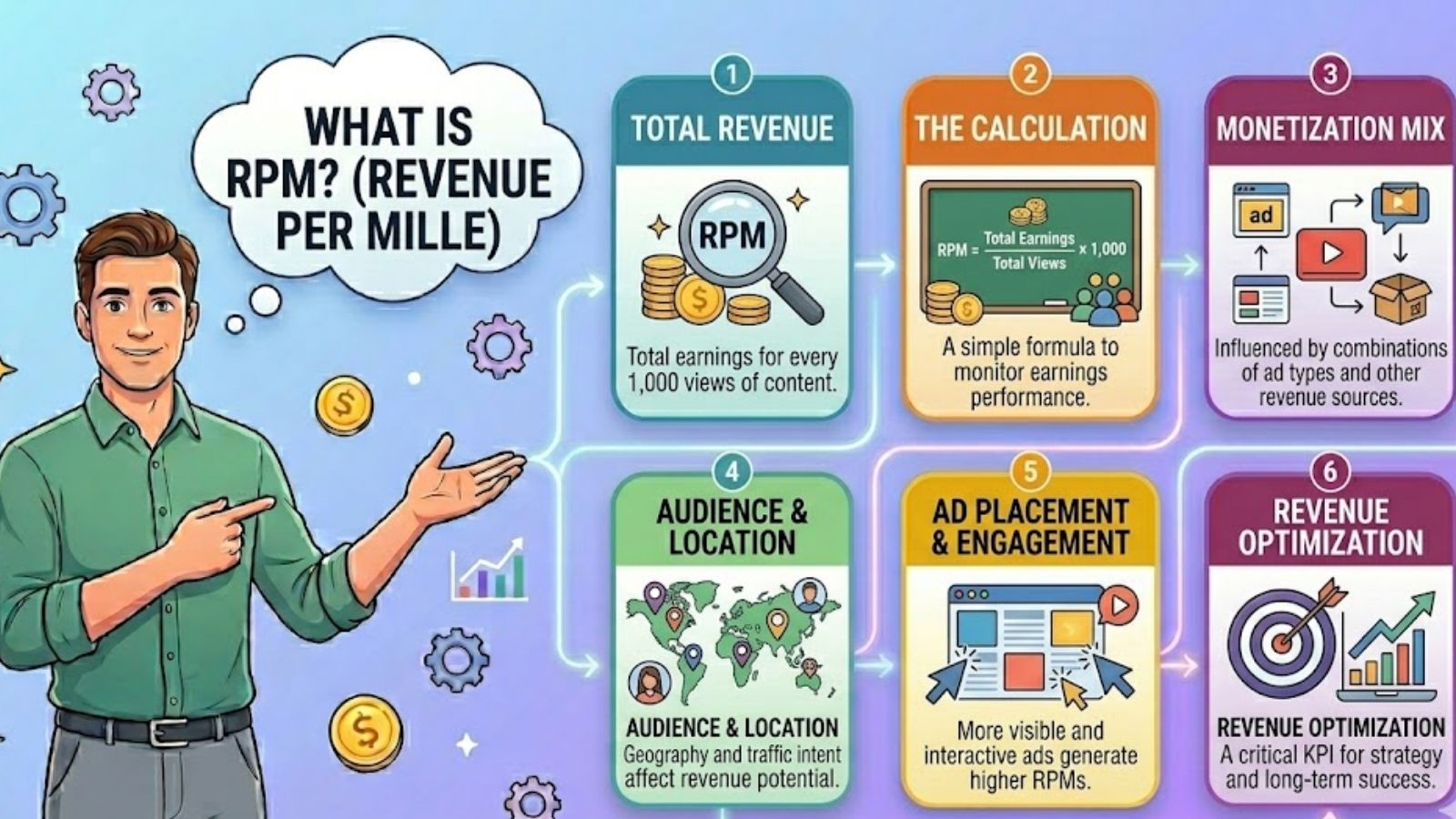
What Is RPM and Why It Matters More Than Traffic
Before diving into strategies, a precise understanding of RPM is essential - because many publishers confuse it with CPM, and the distinction drives fundamentally different optimization decisions.
RPM (Revenue Per Mille) measures how much a publisher earns per 1,000 page views:
RPM = (Total Ad Revenue / Total Page Views) × 1,000
If your site generates $200 in ad revenue from 40,000 page views in a month, your RPM is $5.
CPM (Cost Per Mille) is the advertiser-side metric - what advertisers pay for 1,000 ad impressions. Publishers receive a share of this after the ad network takes its cut.
The critical insight: RPM is the metric publishers control, CPM is the metric advertisers control. Publishers increase RPM by improving the quality and efficiency of how their ad inventory is managed - not by waiting for advertisers to raise their bids.
Why RPM matters more than raw traffic:
A site with 50,000 monthly page views and $20 RPM earns $1,000/month. The same site with $5 RPM earns $250/month - from identical traffic. Doubling RPM from $5 to $10 generates the same revenue increase as doubling your traffic from 50,000 to 100,000 monthly page views - but RPM optimization is typically faster, cheaper, and more within a publisher's direct control.
RPM benchmarks by niche (2026):
For AdSense publishers, anything between $5–$25 is common. However, publishers in finance, tech, or health can see $30+ RPM. Always benchmark against your vertical average rather than chasing a universal good number.
The 3 Core Levers of RPM
There are three fundamental areas publishers can optimize to improve RPM. Every strategy in this guide fits into one of these categories:
1. Demand optimization - increasing the number and quality of advertisers competing for your inventory
2. Inventory optimization - improving how your ad placements are configured to attract higher bids
3. Audience optimization - attracting the traffic profiles that advertisers pay the most to reach
The most impactful RPM improvements come from working all three levers simultaneously. Publishers who only focus on ad placement without addressing demand quality - or who chase traffic volume without improving audience intent - will always leave significant revenue on the table.
Strategy 1: Implement Header Bidding
Header bidding is the single highest-impact change most publishers can make to their RPM. The most effective strategies involve switching to open-source header bidding, connecting to multiple premium SSPs, setting dynamic price floors, and improving Core Web Vitals to attract high-paying buyers.
A waterfall setup tests buyers one at a time. A unified header bidding auction sends the request to all your SSPs simultaneously. This real-time competition forces ad networks to submit their highest price, instantly driving up baseline CPM and overall yield.
When multiple demand sources - Google AdX, Amazon Publisher Services, Rubicon, OpenX, Index Exchange - compete in a simultaneous real-time auction for every impression, your inventory goes to the highest bidder rather than the first bidder willing to meet your floor. Publishers switching from AdSense-only to header bidding typically report RPM increases of 40–150% depending on their traffic quality and niche.
Implementation options in 2026:
- Prebid.js - Open-source, full control, requires technical implementation and ongoing management
- Ezoic - Managed header bidding with AI optimization; handles Prebid configuration automatically
- Setupad / MonetizeMore / PubPower - Managed services that build and maintain header bidding infrastructure for publishers
- Google Open Bidding - Google's server-side header bidding solution, accessible through Google Ad Manager
For publishers without in-house technical resources, managed platforms are the fastest path to header bidding implementation. You do not need an in-house engineering team. Building a Prebid wrapper from scratch, negotiating individual SSP contracts, and constantly tweaking timeout logic is a full-time job - managed services automate that entire process.
Strategy 2: Optimize Ad Viewability
Ad viewability is one of the most important factors influencing RPM. If an ad is never seen by users, it does not generate meaningful revenue - and more critically, low viewability signals to premium demand sources that your inventory is low quality, causing them to bid less aggressively on every impression across your entire site.
High viewability attracts premium demand and higher bids. Fast-loading pages improve viewability, reduce bounce rates, and boost SEO rankings - all of which contribute to higher RPM.
Google considers an ad viewable when at least 50% of the ad is visible on screen for at least one second (display) or two seconds (video). Premium advertisers using programmatic buying often set minimum viewability thresholds of 60–70% - meaning your inventory is excluded from their campaigns entirely if your viewability scores fall below their requirements.
Actionable viewability improvements:
- Place ads above the fold where users are likely to see them without scrolling
- Implement sticky ad units - sidebar and footer sticky ads maintain viewability throughout the session
- Use lazy loading only for below-fold ads - ensure above-fold ads load immediately
- Avoid stacking multiple ads in a single viewport area, which creates competition between your own units
- Monitor viewability scores per placement in Google Ad Manager and pause any placement consistently below 50%
High viewability increases CTR and CPC, which naturally improve Page RPM without increasing ad density - making it one of the highest-return optimizations available at zero additional cost.
Strategy 3: Diversify Demand Sources
Publishers who rely on a single ad network - even one as large as AdSense - are structurally limited in their RPM ceiling. A single demand source means one pool of advertisers competing for your inventory. More demand sources means more competition, which means higher clearing prices.
The January 2026 AdSense infrastructure disruptions - which caused 50–90% revenue drops for publishers relying exclusively on Google demand - also demonstrated that single-source dependency is not just a revenue optimization issue, but a business continuity risk.
Building a diversified demand stack:
- Primary: Google Ad Exchange (AdX) via header bidding or a managed partner
- Secondary: Amazon Publisher Services - adds Amazon's advertiser demand which is absent from AdSense
- Tertiary: Rubicon (Magnite), OpenX, Index Exchange, or PubMatic via Prebid.js
- Direct deals: Sponsors and direct advertisers in your niche paying premium floor CPMs
Each additional demand source adds competitive pressure to every auction. Publishers commonly report 15–30% RPM improvements simply from adding Amazon header bidding alongside their existing Google demand, because Amazon's advertiser pool does not overlap significantly with Google's, creating genuine new competition.
Strategy 4: Set and Optimize Price Floors
Price floors are minimum CPM thresholds below which you refuse to serve an ad. Without price floors, advertisers know they can win your inventory at minimal cost during low-demand periods - depressing your effective RPM even when demand is available at higher prices.
Dynamic price floors - which adjust automatically based on real-time auction signals, historical performance by placement, and geographic targeting - consistently outperform static floor settings because they match your price requirements to actual market demand rather than a fixed arbitrary number.
Price floor strategy in 2026:
- Set global price floors based on your niche baseline CPM data (e.g., $1.50 floor for general content, $5.00 floor for finance content in US traffic)
- Use Google Ad Manager's dynamic floor pricing to automatically optimize floors based on real-time auction data
- Implement geo-specific floors - US and UK traffic justifies floors 3–5x higher than Tier 2 traffic
- Set placement-specific floors based on historical performance - your highest-viewability in-content placement deserves a higher floor than a below-fold sidebar
- Monitor fill rates alongside RPM - extremely high fill rates often signal floors set too low; extremely low fill rates signal floors set too high
Price floors work best when combined with header bidding because they protect revenue during low-demand periods without reducing the competitive pressure that drives premium bids during high-demand moments.
Strategy 5: Improve Page Speed and Core Web Vitals
Page speed directly impacts RPM through three interconnected mechanisms: it affects ad viewability (faster pages show more ads to more users), it influences Google's organic rankings (faster pages attract more high-quality traffic), and it affects how premium demand sources evaluate your inventory quality in programmatic auctions.
Fast-loading pages improve viewability, reduce bounce rates, and boost SEO rankings - all of which contribute to higher RPM.
Publishers with poor Core Web Vitals scores are increasingly excluded from premium programmatic demand sources. In 2026, Google's advertising ecosystem - including Google Ad Exchange - uses site quality signals in its inventory evaluation, meaning slow pages effectively earn lower CPMs even before any placement optimization takes effect.
Page speed optimization priorities for publishers:
- Target Largest Contentful Paint (LCP) under 2.5 seconds - critical for above-fold ad viewability
- Minimize Cumulative Layout Shift (CLS) below 0.1 - layout shifts cause users to accidentally click (and immediately close) ads, inflating invalid click rates
- Use Interaction to Next Paint (INP) optimization - keeps pages responsive even when multiple ad scripts are loading
- Implement Ezoic Leap or similar server-side optimization if using a managed ad platform
- Use a CDN (Content Delivery Network) to reduce server response times globally
- Compress images and defer non-critical JavaScript loading
Publishers who improve their Core Web Vitals scores from "needs improvement" to "good" typically see RPM improvements of 15–35% from better viewability rates and increased premium demand access alone.
Strategy 6: Test and Optimize Ad Placement
Where your ads appear on the page - and how many ad units you run per page - has a direct and measurable impact on RPM. Publishers should ensure that they are keeping both CTR and CPC as high as possible since increasing these two metrics will drive the growth of their page RPM.
Highest-performing ad placements in 2026:
The three placement types that consistently generate the highest RPM are:
- In-content ads (after the 2nd or 3rd paragraph): Catch readers in the highest-attention moment of their visit - early in the article before interest drops
- Sticky sidebar units: Maintain viewability throughout the session; a reader who scrolls 80% down the page still sees the sticky ad
- Sticky footer/header units (mobile): Mobile sticky units achieve the highest viewability rates of any ad format on smartphones, where over 70% of traffic now arrives
Placement testing framework:
Use A/B testing to compare placement variations. Run each test for a minimum of one week with a statistically significant sample before drawing conclusions. The actions you take to boost your page RPM will not necessarily have an immediate effect - meaningful tests require patience and proper sample sizes.
What to avoid:
- Placing ads below the fold without sticky functionality - low viewability with minimal upside
- Running more than 3–4 ad units per page - diminishing returns beyond this threshold, with user experience degradation that increases bounce rates and reduces session depth
- Placing multiple ad units in the same viewport simultaneously - creates internal competition between your own placements
Strategy 7: Use High-CPM Ad Formats
Not all ad formats generate equal CPMs. Video ads, sticky units, and native placements often deliver higher RPM due to better engagement and viewability. Test responsive display ads across devices and blend ad types strategically.
Ad format CPM hierarchy in 2026 (high to low):
- Video ads (outstream): Highest CPMs of any format - 2–5x display CPMs in the same niche and placement. Outstream video plays within content without requiring video content to host.
- Sticky adhesion units: High viewability by design; consistently outperform standard display in RPM
- Responsive display ads: Adapt automatically to available ad space; fill rates are higher than fixed-size units
- Native ads: Match the look of surrounding content; lower CPMs than display but higher CTR - balances revenue with user experience
- Standard display (300×250, 728×90, 320×50): Baseline - the reference against which other formats are measured
Implementation priority: Add at least one outstream video unit per article if your ad network supports it. Outstream video requires no existing video content and can generate 2–4x the CPM of a display unit in the same placement - making it one of the fastest RPM improvement levers available to content publishers.
Strategy 8: Target and Attract Higher-Value Traffic
Traffic quality is as important as traffic volume when it comes to RPM. The same article generating $20 RPM from US organic search traffic might generate $4 RPM from social media traffic - not because the content is different, but because the audience intent and geographic profile are.
Traffic quality factors that directly influence RPM:
- Geographic origin: US, UK, Australia, and Canada generate 3–10x higher CPMs than Tier 2 and Tier 3 markets
- Traffic source: Organic search traffic carries the highest advertiser confidence and generates the best CPMs; paid social and referral traffic generates lower CPMs
- Audience intent: Visitors who arrive through informational or commercial search queries are in active research mode - advertisers pay more to reach them
- Session depth: Visitors who read 3+ pages per session generate more ad impressions per visit, directly increasing RPM
Strategies to improve traffic quality:
- Build content specifically targeting US and UK search queries - even if your site is not based in those markets
- Use buyer-intent keywords in your content strategy: "best," "compare," "review," "top," "cheapest" - these keywords attract audiences that advertisers pay the most to reach
- Improve internal linking to increase pages per session - a visitor who reads 3 articles generates 3x the ad impressions of a single-page visitor
- Minimize low-quality traffic sources: bot traffic, incentivized traffic, and click farms actively suppress RPM by signaling to programmatic buyers that your inventory is low quality
Strategy 9: Block Low-Paying Ad Categories
Ad networks serve ads from all categories by default - but not all categories pay equally. Categories like "Apparel," "Arts and Entertainment," and "Hobbies and Leisure" consistently have low CPMs because the advertisers in those categories have limited budgets and low customer lifetime values. Meanwhile, those low-paying ads consume inventory that could be filled by higher-paying categories.
To improve RPM: blocking low-paying ad categories ensures that when those categories would win an impression, the ad server moves to the next bidder rather than serving a $0.50 CPM ad when a $2.00 CPM ad from another category could fill the same slot.
Categories typically worth blocking for RPM improvement:
- Apparel and accessories (very low CPMs)
- Arts and crafts
- Games and video games (unless gaming is your niche)
- Pets (unless pet content is your niche)
- Dating and personals (can also cause brand safety issues)
- Job listings and classified ads
How to implement in AdSense / GAM: In your Google AdSense account, navigate to Brand Safety → Content → Blocking Controls → Ad category blocking. Disable categories with historically low CPM contributions to your revenue. Monitor fill rates for two weeks after blocking to ensure you have not removed categories that were your primary fill - then evaluate RPM impact.
Important caveat: Do not block categories blindly. Use AdSense's ad category performance report to identify which categories are actually generating low CPMs on your specific site before blocking them. Categories that underperform on average can still be high performers for specific niches.
Strategy 10: Implement Ad Refresh
Ad refresh is a technique that reloads ad units for users who spend extended time on a single page - generating additional impressions (and revenue) from long-session visitors without requiring additional page views.
A reader who spends 8 minutes on a long-form article generates only one set of ad impressions under a standard setup. With ad refresh enabled and set to a 30-second interval, that same reader generates up to 16 sets of impressions - dramatically increasing revenue per session for engaged users.
Ad refresh implementation guidelines in 2026:
- Minimum refresh interval: 30 seconds (per Google AdX policy - shorter intervals are policy violations)
- Target only engaged users: only refresh ads for users who have shown active engagement signals (scrolling, mouse movement, tab visibility)
- Use viewability-gated refresh: only refresh ads that are currently in the user's viewport - refreshing below-fold ads that aren't being seen generates impressions without value
- Apply refresh to high-engagement content: long-form articles, tutorials, and guides benefit most - thin content pages with 60-second average sessions gain little from refresh
Ad refresh can increase RPM by 20–50% for content sites where session times exceed 3–4 minutes, with minimal negative impact on user experience when implemented with proper engagement gating.
Strategy 11: Upgrade to a Premium Ad Network
The ad network you use determines which advertisers can reach your inventory and at what CPM rates. Publishers using basic AdSense - without any additional demand sources or network upgrades - are accessing only a fraction of available programmatic demand.
Ad network upgrade path by traffic level:
- Under 10,000 monthly sessions: Google AdSense + Ezoic Access Now (adds header bidding, AI optimization)
- 10,000 – 50,000 monthly sessions: Ezoic (full access) or Setupad; adds multiple demand sources beyond AdSense
- 50,000 – 100,000 monthly sessions: Mediavine (food, travel, lifestyle focus) or Ezoic Premium
- 100,000+ monthly sessions: Raptive (formerly AdThrive) or direct Prebid.js setup with managed partner
Publishers who upgrade from AdSense-only to a managed header bidding platform like Mediavine or Raptive typically report RPM improvements of 60–200% in their first year - driven by demand diversification, AI-optimized placements, and access to premium direct deal inventory that AdSense alone cannot deliver.
Strategy 12: Leverage Seasonal RPM Peaks
CPM rates are not constant throughout the year - they follow a predictable seasonal pattern that publishers can plan around to maximize annual revenue.
The RPM seasonal calendar in 2026:
- Q1 (January – March): Lowest CPMs of the year. Advertisers have depleted Q4 budgets; new fiscal year budgets are still being allocated. RPMs typically 30–50% below Q4 peaks.
- Q2 (April – June): Moderate recovery. Spring buying season and mid-year budget deployment improves CPMs gradually.
- Q3 (July – September): Mixed. August and early September begin the back-to-school advertising surge in education, retail, and electronics.
- Q4 (October – December): Peak season. Holiday advertising demand drives CPMs to annual highs. November and December often generate 2–3x the RPM of January from the same traffic volume.
Q4 RPM maximization strategies:
- Publish your highest-value content in October and November to capture peak advertiser demand
- Increase ad density slightly during November and December - user tolerance for ads is higher during holiday season
- Set higher price floors in Q4 - advertiser demand supports higher minimums during the holiday period
- For content sites: plan seasonal articles (gift guides, year-end roundups, holiday buying guides) that capture both peak search traffic and peak CPMs simultaneously
RPM Optimization Comparison: Impact vs. Implementation Effort
| Strategy | RPM Impact | Implementation Difficulty | Time to See Results |
|---|---|---|---|
| Header Bidding | Very High (+40–150%) | Medium–High | 2–4 weeks |
| Ad Viewability Optimization | High (+20–50%) | Low–Medium | 1–2 weeks |
| Demand Diversification | High (+20–60%) | Medium | 2–4 weeks |
| Dynamic Price Floors | High (+15–40%) | Medium | 1–2 weeks |
| Page Speed / Core Web Vitals | Medium–High (+15–35%) | Medium–High | 4–8 weeks |
| Ad Placement A/B Testing | Medium (+10–30%) | Low | 2–4 weeks |
| High-CPM Ad Formats (Video) | High (+20–80%) | Medium | 1–2 weeks |
| Traffic Quality Improvement | Medium (+10–40%) | Medium–High | 4–12 weeks |
| Ad Category Blocking | Low–Medium (+5–20%) | Very Low | 1 week |
| Ad Refresh | Medium–High (+20–50%) | Medium | 1–2 weeks |
| Network Upgrade | Very High (+60–200%) | Low–Medium | 2–6 weeks |
| Seasonal Q4 Planning | High (varies) | Low | Quarterly |
Frequently Asked Questions (FAQ)
Q: What is a good RPM for a website in 2026? A good RPM depends on your content niche and traffic geography. For general content sites targeting US traffic, $5–$15 RPM is typical with standard AdSense. Finance, insurance, and legal sites targeting US traffic can achieve $20–$50+ RPM with proper demand optimization. As a benchmark, if your RPM is below the average for your niche and Tier 1 traffic, you have meaningful optimization opportunity available. Never compare your RPM to another niche - the benchmarks are fundamentally different.
Q: Why did my RPM suddenly drop? Sudden RPM drops have several common causes: Q1 seasonality (advertisers reducing budgets after Q4), Google policy changes affecting your content categories, a traffic source shift (new social traffic replacing organic search), an ad network or partner experiencing technical issues, or a Core Web Vitals degradation reducing your viewability scores. Check your AdSense Policy Center for new flags, review your traffic sources in Google Analytics, and audit your page speed scores whenever an unexplained RPM drop occurs.
Q: How long does it take to increase RPM after implementing changes? Most RPM optimizations take 1–4 weeks to show measurable results, because ad networks need time to collect data, update their quality assessments of your inventory, and adjust their bidding algorithms. A/B tests require at least one week with a significant sample size before evaluating results. Header bidding optimizations typically show initial improvement within days but reach full optimization after 30–60 days as algorithms learn your traffic patterns.
Q: Does more ad units mean higher RPM? Not necessarily - and often the opposite. Adding more ad units beyond 3–4 per page creates diminishing returns and frequently reduces RPM because: it increases page load time (hurting viewability for all units), it increases layout shift (hurting user engagement and inflating invalid click signals), and it distributes the same advertiser demand across more impressions, reducing competition per unit. Focus on fewer, higher-quality, better-positioned units rather than maximizing unit count.
Q: Should I use AdSense auto ads or manual placement? In 2026, manual placement combined with responsive ad unit types generally outperforms fully automated Auto Ads for publishers who are actively managing their monetization. Auto Ads can be a useful starting point, but they prioritize Google's optimization goals rather than yours - which may favor impression volume over RPM. Manual placements give you control over viewability, format mix, and floor pricing that Auto Ads do not. If you are currently using Auto Ads only, test a hybrid approach: manual placement for your top 3–4 positions with Auto Ads filling supplementary placements.
Q: What is the difference between RPM and EPMV? RPM measures revenue per 1,000 page views. EPMV (Earnings Per Thousand Visitors) measures revenue per 1,000 unique visitors - accounting for all the pages a single visitor views in a session. EPMV is considered a more accurate measure of monetization efficiency because it captures session depth. A visitor who reads 4 pages generates 4x the ad impressions but is only one visitor - EPMV reflects the full revenue from that session, while RPM only measures individual pages in isolation. Ezoic's analytics platform reports EPMV as its primary metric, and many advanced publishers prefer it over page RPM for strategic decision-making.
Final Verdict: How to Build a Systematic RPM Growth Strategy in 2026
Increasing RPM is not a single action - it is a compounding system of optimizations. The publishers who consistently achieve $20–$50+ RPM are not using one magic strategy. They are stacking: header bidding to increase demand competition, viewability optimization to attract premium buyers, dynamic price floors to protect revenue during low-demand periods, high-CPM ad formats to increase per-impression value, and traffic quality improvements to deliver audiences that advertisers pay more to reach.
The most practical starting point for most publishers is a two-step move: first, add header bidding through a managed platform (Ezoic, Setupad, or similar) to immediately increase demand competition; second, audit and optimize ad placement viewability using the strategies outlined in this guide. These two actions alone typically deliver 50–100% RPM improvements within 60 days - a result that would take years to achieve through traffic growth alone.
RPM optimization is fundamentally more time-efficient than traffic acquisition. While building organic search traffic to double your page views might take 12–24 months of content investment, doubling your RPM from $5 to $10 through demand optimization and placement improvements is achievable in 30–90 days. For publishers focused on sustainable revenue growth, that math is impossible to ignore.
For publishers looking to scale revenue in 2026, understanding the right monetization strategy is becoming just as important as growing traffic itself. At AdsCollab, you can explore in-depth guides on publisher monetization, ad network comparisons, CPM optimization, and programmatic revenue strategies designed to help websites grow sustainably across different niches and traffic sources.
If you’re comparing ad networks or searching for the best platform to improve your RPM and overall ad performance, the detailed publisher resources and monetization frameworks available on AdsCollab publisher guides can help you make a more informed, data-driven decision based on your audience, traffic profile, and content category. Ready to optimize your revenue strategy? Contact us now to connect with the team and explore solutions tailored to your website.

