
Welcome to AdsCollab (adscollab.com), your go-to platform for seamless advertising collaborations that connect publishers, advertisers, and tech innovators to maximize revenue and efficiency. As the digital ad landscape evolves rapidly, AdsCollab empowers users with tools and insights to stay ahead, and in this article, we delve into the transformative world of header bidding in 2026, exploring how this technology is set to redefine programmatic advertising.
Header bidding has long been a cornerstone of modern digital advertising, allowing publishers to auction their ad inventory to multiple demand sources simultaneously. By 2026, this technique is poised for significant advancements, driven by AI integration, privacy regulations, and hybrid implementations. These changes promise higher yields for publishers while addressing longstanding challenges like latency and data privacy. In the following sections, we will break down the fundamentals, trace its evolution, highlight key trends, discuss benefits and challenges, and offer forward-looking predictions to help you navigate header bidding 2026 effectively.
Understanding Header Bidding: The Basics
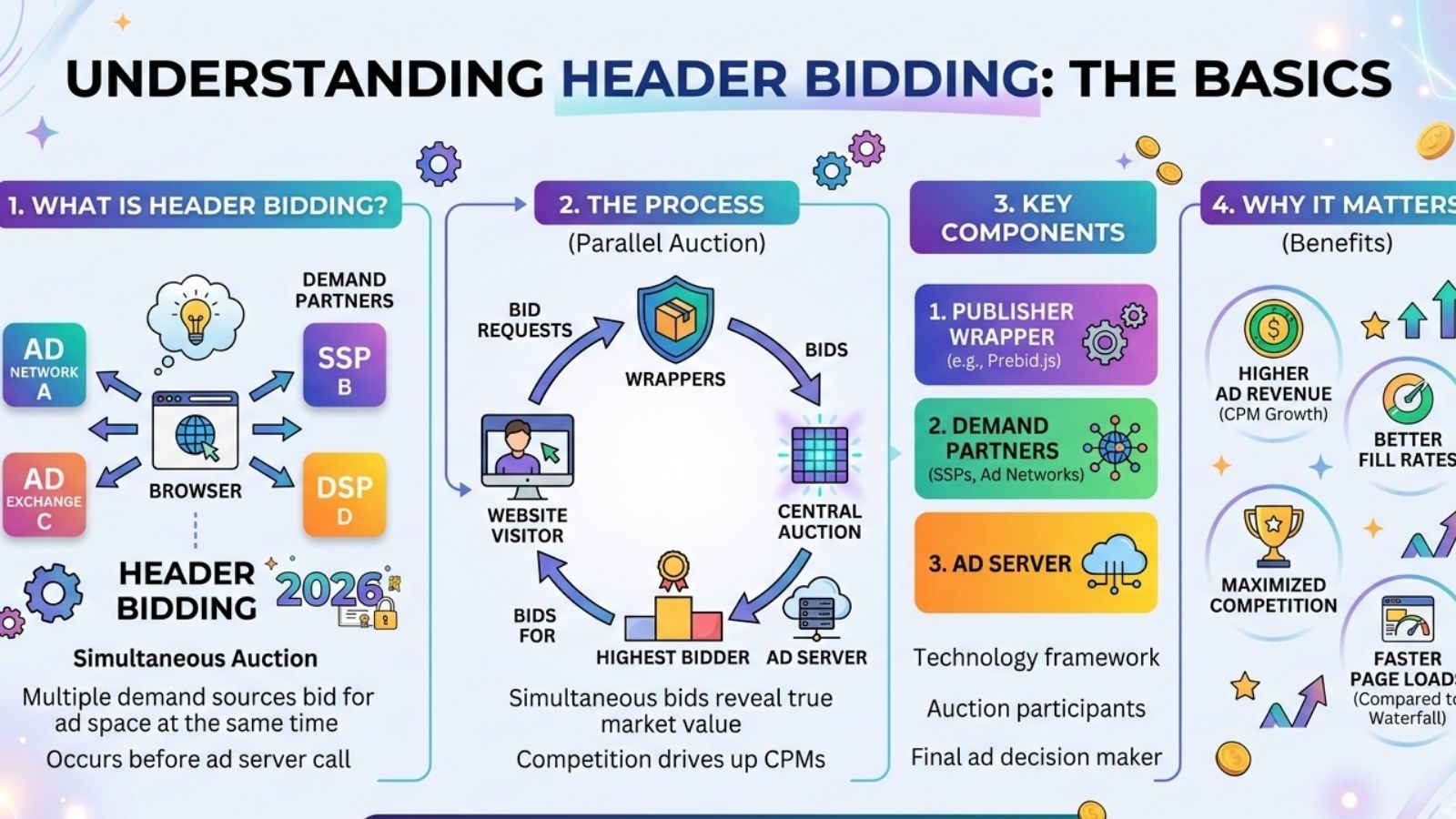
At its core, header bidding is a programmatic advertising method where publishers offer their ad inventory to numerous ad exchanges and demand-side platforms (DSPs) at the same time, right from the header of their webpage. This happens before the ad server is even called, enabling a real-time auction that maximizes competition and revenue. Unlike the traditional waterfall setup, where demand sources are prioritized in a sequential hierarchy, header bidding levels the playing field, ensuring every bidder has an equal shot at the inventory.
The process begins with a snippet of JavaScript code embedded in the page header. When a user loads the page, this code sends bid requests to multiple SSPs (supply-side platforms) and DSPs. These platforms evaluate the request based on user data such as demographics, browsing behavior, and device type, then submit bids within a strict timeout window—typically 1000 to 3000 milliseconds. The highest bid is selected and forwarded to the publisher's ad server, which may compare it against direct deals or other priorities before serving the ad.
This mechanism relies heavily on real-time bidding (RTB), a second-price auction model where the winner pays just one cent more than the second-highest bid. Tools like Prebid.js, an open-source header bidding wrapper, manage this orchestration by handling bid collection, timeouts, and analytics. For publishers, this translates to greater transparency, as they gain insights into bid values, win rates, and partner performance, enabling data-driven optimizations.
In 2026, these basics remain foundational, but enhancements like AI-driven bid predictions and privacy-focused data handling are elevating the game. Publishers using header bidding report average CPM increases of 20-50%, underscoring its enduring value in a competitive market.
The Evolution of Header Bidding Leading to 2026
Header bidding emerged in the early 2010s as a response to the inefficiencies of the waterfall model, which often left revenue on the table due to its tiered structure and passbacks. Early adopters integrated it client-side, where bids are processed in the user's browser, fostering true competition and democratizing access to demand. By the mid-2010s, wrappers like Prebid standardized the process, incorporating machine learning for bid forecasting and reducing implementation complexities.
The shift to server-side header bidding (also known as server-to-server or S2S) addressed client-side limitations, such as browser latency from multiple bid requests. In S2S, auctions occur on a remote server, allowing for more demand partners without slowing page loads. This evolution has been crucial for scaling, especially in mobile and video environments where speed is paramount.
Looking toward 2026, the evolution accelerates with hybrid models that combine client- and server-side auctions. These hybrids maximize competition by running parallel processes, increasing fill rates and revenue—studies show lifts of over 18% for publishers adopting this approach. Privacy concerns, amplified by the deprecation of third-party cookies, have pushed the industry toward first-party data and contextual targeting. Google's Privacy Sandbox and similar initiatives are integrating with header bidding wrappers to maintain efficacy without compromising user trust.
Moreover, the rise of AI has transformed header bidding from a static auction to a dynamic, predictive system. Machine learning algorithms now forecast bid outcomes, optimize timeouts based on network conditions, and even curate inventory packages before auctions. This progression ensures header bidding 2026 is not just about speed but about intelligent, sustainable monetization in a cookieless world.
Key Trends in Header Bidding for 2026
As we approach 2026, several trends are reshaping header bidding, making it more efficient and adaptable. One prominent trend is the widespread adoption of hybrid header bidding, where client-side and server-side methods coexist to boost competition and fill rates. This approach allows publishers to handle more demand sources without latency issues, directly contributing to higher revenue.
AI integration is another game-changer. In 2026, AI will dominate programmatic workflows, automating bid optimizations, A/B testing, and performance forecasting. Agentic AI, which acts autonomously, will reduce manual interventions, potentially increasing revenue by 20-30% through real-time adjustments. This ties into attention metrics, where bids are evaluated not just on viewability but on user engagement, ensuring ads are noticed and remembered.
Privacy-first strategies are non-negotiable. With third-party cookies crumbling, header bidding will rely on identity graphs and data clean rooms for secure, first-party data sharing. Contextual intelligence, enhanced by AI, will analyze content tone and user intent for precise targeting, as demonstrated by campaigns achieving significant cost reductions.
Supply path optimization (SPO) and demand path optimization (DPO) will streamline header bidding by trimming intermediaries, improving transparency, and reducing costs. Publishers will increasingly curate inventory on the sell-side, packaging it with enriched data for higher CPMs in auctions.
Emerging formats like connected TV (CTV) and digital out-of-home (DOOH) are integrating header bidding, with CTV ad spend projected to reach $26 billion in the US by 2026. Programmatic audio and outstream video ads will extend header bidding's reach, offering new monetization avenues in non-visual and mobile environments.
Sustainability in ad tech, or Green AdTech, will influence header bidding by minimizing carbon footprints from high-volume auctions. Initiatives to reduce unnecessary bids will align with global regulations, making eco-friendly practices a competitive edge.
These trends collectively position header bidding 2026 as a resilient tool in a maturing programmatic ecosystem, focused on quality over quantity.
Benefits of Header Bidding in the 2026 Landscape
The advantages of header bidding are amplified in 2026's dynamic environment. Foremost is revenue maximization through simultaneous bidding, which fosters true market pricing and reduces reliance on single demand sources. Publishers can expect stable income streams, with diverse partners mitigating risks from market fluctuations.
Transparency is a key benefit, providing granular data on bids and performance. This empowers optimizations, such as dynamic price floors based on audience segments or time of day, leading to smarter inventory management.
Control remains with publishers, who can select partners and set rules without intermediaries dictating terms. In a privacy-centric world, header bidding supports first-party data utilization, maintaining targeting accuracy while complying with GDPR and similar laws.
For advertisers, it means access to premium inventory at fair prices, with AI ensuring bids align with campaign goals. Overall, header bidding 2026 enhances ecosystem efficiency, driving programmatic display ad spending to projected $436 billion.
Header bidding 2026 is best for
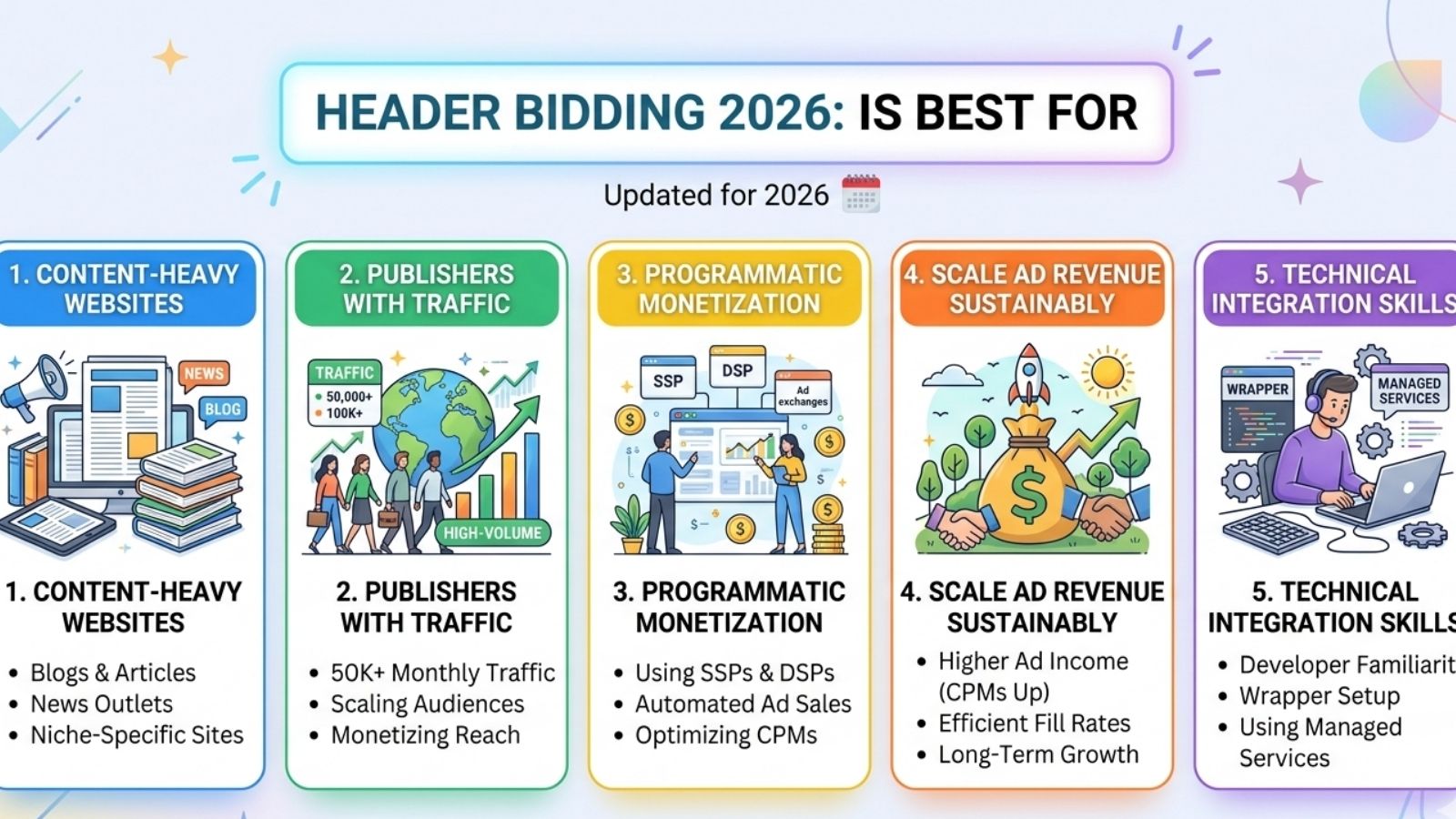
- Content-heavy websites (blogs, news, niche sites)
- Publishers with 50K+ monthly traffic
- Sites using programmatic monetization
- Businesses wanting to scale ad revenue sustainably
- Developers comfortable with technical integration or using managed services
Challenges and Solutions in Header Bidding 2026
Despite its strengths, header bidding faces hurdles in 2026. Latency from multiple bid requests can slow page loads, impacting user experience and SEO. Solutions include server-side implementations and dynamic timeouts adjusted for device and connection speed.
Privacy regulations pose challenges, but innovations like clean rooms and contextual AI provide workarounds, enabling compliant data use. Fragmented supply paths lead to waste, estimated at $26.8 billion globally, but curation and SPO streamline processes for better ROI.
Implementation complexity requires technical expertise; wrappers like Prebid simplify this, with A/B testing ensuring smooth rollouts. Sustainability concerns from energy-intensive auctions are addressed through optimized bidding algorithms that reduce redundant requests.
By proactively tackling these issues, publishers can harness header bidding's full potential in 2026.
Comparison Table: Header Bidding vs Waterfall
| Feature | Header Bidding 2026 | Traditional Waterfall |
|---|---|---|
| Auction Type | Simultaneous | Sequential |
| Revenue Potential | High (20–50% lift) | Lower |
| Transparency | Full visibility | Limited |
| Speed | Optimized with hybrid setup | Slower passbacks |
| AI Optimization | Yes | Minimal |
| Best For | Scalable publishers | Small/basic sites |
Predictions and Case Studies for Header Bidding 2026
Looking ahead, header bidding will integrate deeply with AI agents for autonomous optimizations, reshaping discovery in zero-click search environments. Hybrid models will become standard, with publishers reporting consistent revenue uplifts.
Case in point: A publisher using Adnimation's hybrid setup saw an 18% revenue increase by blending client- and server-side auctions, highlighting practical gains. Another example from Nissan demonstrates AI-contextual targeting in header bidding reducing costs by 68%, proving its efficacy in real-world campaigns.
In CTV and audio, header bidding will expand, with programmatic audio spending hitting $2.6 billion. Overall, predictions point to a more curated, AI-driven landscape where header bidding drives sustainable growth.
FAQs About Header Bidding 2026
1. Is header bidding still effective in 2026?
Yes, it remains one of the most effective monetization strategies, especially with AI and hybrid setups.
2. How much revenue increase can I expect?
Most publishers see 20–50% higher CPMs compared to waterfall models.
3. Does header bidding affect site speed?
It can, but hybrid and server-side setups minimize latency.
4. Do I need technical skills?
Basic setup requires coding, but managed platforms simplify the process.
5. Is header bidding compliant with privacy laws?
Yes, when implemented with first-party data and consent management tools.
How AdsCollab Supports Header Bidding Strategies
At AdsCollab (adscollab.com), we provide collaborative tools to implement and optimize header bidding setups. Our platform connects you with demand partners, offers analytics for performance tracking, and supports hybrid integrations to future-proof your strategy in 2026.
- Learn about programmatic monetization strategies to diversify revenue
- Explore our contact page for custom setup support
- Discover tools for ad revenue optimization and analytics on AdsCollab
Conclusion
Header bidding 2026 represents a pinnacle of programmatic innovation, blending AI, privacy, and efficiency to empower publishers and advertisers alike. By embracing these trends, you can unlock new revenue horizons. Visit AdsCollab.com to get started and stay ahead in this evolving space

