.jpg)
Welcome to AdsCollab, your collaborative advertising platform that connects publishers with premium demand partners, streamlined header bidding integrations, and performance-optimized tools to maximize revenue in today's programmatic ecosystem. As publishers seek the perfect balance between competition, speed, and scalability, hybrid header bidding has emerged as a leading solution in 2026 - combining the strengths of client-side and server-side approaches to deliver higher yields and better user experiences.
Hybrid header bidding represents the evolution of programmatic advertising technology, blending client-side auctions (running in the user's browser for transparency and high match rates) with server-side auctions (processed on remote servers for reduced latency and greater scale). This dual approach addresses the limitations of pure client-side or server-side setups, making it a go-to strategy for publishers aiming to boost revenue while maintaining fast page loads. In 2026, with ongoing privacy shifts, AI optimizations, and rising video demand, hybrid header bidding stands out as a flexible, future-proof method that many experts consider the new standard.
What Is Hybrid Header Bidding?
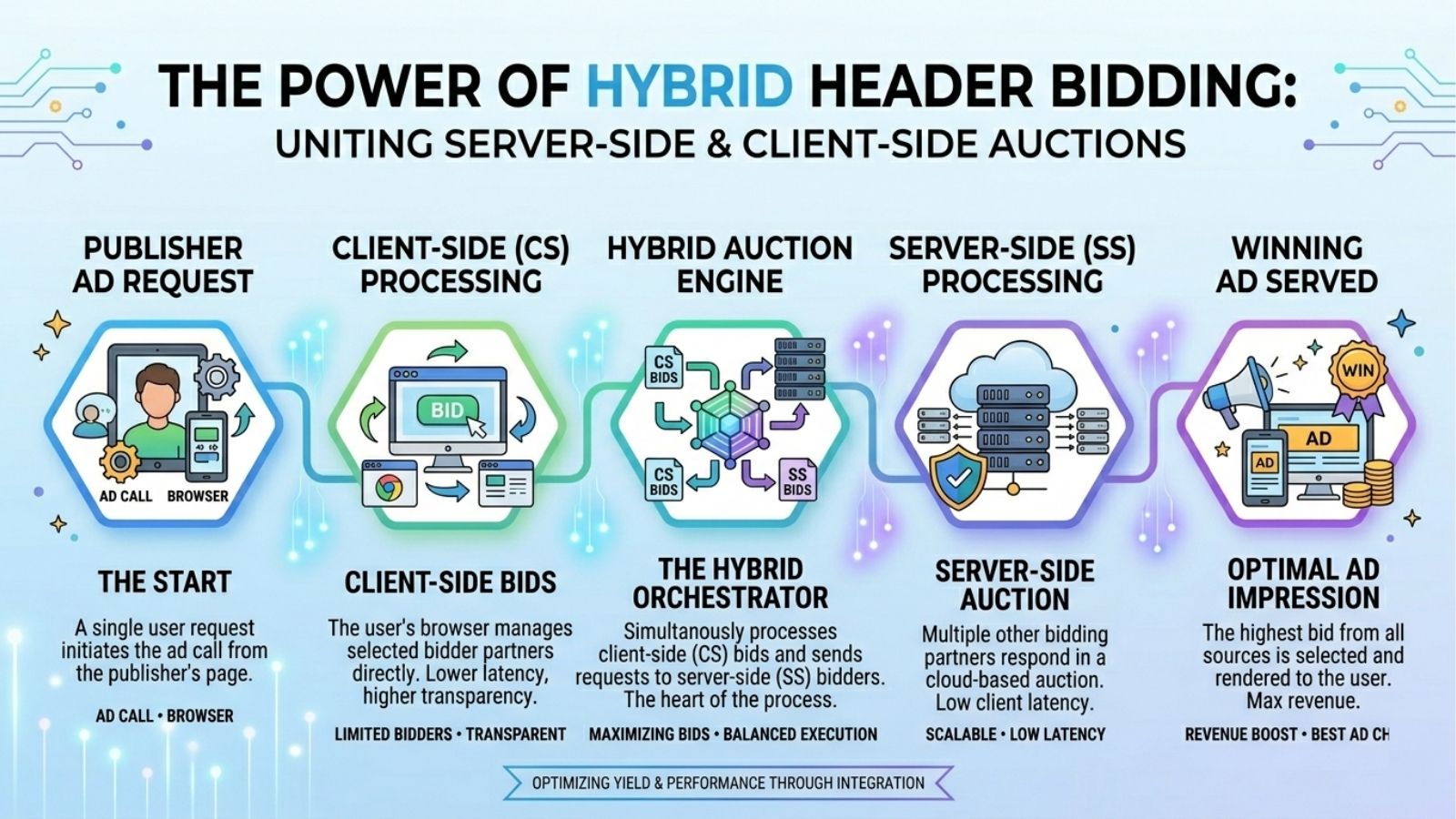
Hybrid header bidding integrates client-side and server-side header bidding into a unified system. In client-side setups (using tools like Prebid.js), bid requests occur in the browser, allowing direct access to user data for better targeting and cookie matching. Server-side (or Prebid Server) moves auctions to a dedicated server, enabling more demand partners without overloading the browser.
In a hybrid model, publishers route select demand sources client-side (often high-value or transparent partners) while sending others server-side (for volume and speed). This creates parallel or layered auctions: client-side handles premium, data-rich bids, while server-side scales for broader competition. The winning bid from both paths feeds into the ad server (like Google Ad Manager) for final selection.
This setup leverages Prebid.js for client-side orchestration and Prebid Server for S2S connections, often with dynamic routing based on device, geography, or inventory type.
Client-Side vs Server-Side vs Hybrid: Key Differences
| Feature | Client-Side | Server-Side | Hybrid Header Bidding |
|---|---|---|---|
| Speed | Slower with many bidders | Faster | Balanced |
| Scalability | Limited | High | High |
| Transparency | High | Lower | Medium–High |
| Cookie Match Rate | Strong | Weaker | Optimized |
| Revenue Potential | Medium | Medium–High | High |
| Complexity | Low | Medium | High |
Key takeaway: Hybrid header bidding combines transparency + scale, making it the most flexible and performance-driven approach.
Client-side header bidding offers full transparency, strong bid density from browser-based cookie syncing, and easier setup but risks latency as more partners increase browser load and page slowdowns. It excels on desktop with high-end devices but struggles on mobile or slow networks.
Server-side header bidding shifts processing away from the browser, supporting dozens of partners with minimal latency impact, better scalability, and improved privacy (less client-side data exposure). However, it may reduce transparency and cookie match rates since user data isn't directly accessible in the browser.
Hybrid header bidding combines these: client-side for transparency and premium demand (higher match rates), server-side for scale and speed (more partners, lower latency). Tests show hybrid often outperforms pure setups—parallel bidding (a hybrid variant) delivers slight revenue edges with better viewability, while maintaining speed advantages over client-side alone.
Benefits of Hybrid Header Bidding for Publishers
The primary advantage is revenue maximization. By increasing competition through more demand sources without severe latency, publishers see higher CPMs and fill rates. Studies indicate hybrid implementations lift revenue by 18% or more on average, with some reporting 20-30% gains from optimized parallel auctions.
It improves user experience: faster page loads enhance Core Web Vitals, boosting SEO and engagement—key for ad viewability and session depth. Hybrid reduces browser strain, supporting mobile traffic where speed matters most.
Transparency remains high for client-side partners, while server-side adds volume. In a cookieless era, hybrid supports first-party data and universal IDs better by balancing match rates.
Additional perks include flexibility: dynamic bidder allocation based on user conditions, reduced ad tech tax via optimized paths, and easier integration with video or CTV formats.
Challenges and Drawbacks of Hybrid Header Bidding
.png)
Complexity tops the list—managing dual systems requires careful configuration to avoid bid duplication, inconsistent pricing, or latency spikes. Setup and monitoring demand technical expertise or managed services.
Potential revenue cannibalization arises if not tuned properly: overlapping bids can confuse auctions. Server-side may lower match rates for some partners, impacting targeted demand.
Implementation costs and ongoing optimization add overhead, though managed wrappers mitigate this.
How to Implement Hybrid Header Bidding in 2026
Start with Prebid.js as the client-side wrapper—add adapters for key partners. Integrate Prebid Server for S2S connections to additional SSPs/DSPs.
Configure parallel bidding: run client-side and server-side auctions simultaneously, then merge results (highest bid wins). Use dynamic timeouts and bidder prioritization.
Best practices include: segment bidders (premium on client-side, volume on server-side); test with A/B splits; monitor metrics like bid response time, win rate, and latency; apply user segmentation for tailored pools; set performance budgets.
Tools like managed platforms simplify rollout, handling configs and optimizations.
Hybrid Header Bidding in Video and Emerging Formats
Video header bidding benefits hugely from hybrid: server-side reduces latency for outstream/in-stream, while client-side ensures better targeting. In 2026, with programmatic video spend surging, hybrid enables premium CPMs in CTV and mobile video.
It supports shoppable and native units by maintaining speed for interactive formats.
How to Implement Hybrid Header Bidding (Step-by-Step)
Step 1: Set Up Client-Side Bidding
Use Prebid.js to integrate key demand partners directly in the browser.
Step 2: Integrate Server-Side Bidding
Connect additional demand sources via Prebid Server or similar solutions.
Step 3: Configure Bid Routing
Decide which partners run client-side vs server-side based on performance.
Step 4: Enable Parallel Auctions
Run both auctions simultaneously to maximize competition.
Step 5: Optimize Timeouts
Balance latency and bid participation using dynamic timeout settings.
Step 6: Monitor Key Metrics
Track performance regularly:
- Bid response time
- Win rate
- Fill rate
- Revenue per session
Step 7: Continuously Optimize
Adjust bidder allocation, pricing floors, and routing logic over time.
Best Practices for Hybrid Header Bidding
- Prioritize premium bidders client-side
- Use server-side for scale
- Avoid too many client-side bidders
- Test configurations with A/B experiments
- Monitor latency closely
- Optimize for mobile-first performance
Frequently Asked Questions (FAQ)
1. Is hybrid header bidding better than client-side only?
Yes. It balances transparency and scale, often delivering better revenue and performance.
2. Does hybrid header bidding improve page speed?
Yes. Server-side processing reduces browser load, improving performance.
3. Is hybrid setup difficult?
It can be complex, especially without technical resources. Many publishers use managed solutions.
4. Can small websites use hybrid header bidding?
They can, but simpler setups may be more efficient at early stages.
5. Does hybrid header bidding work for mobile?
Yes, and it’s particularly useful for mobile due to latency optimization.
How AdsCollab Supports Hybrid Header Bidding
Managing hybrid header bidding manually can be complex. AdsCollab simplifies the process by combining demand access, performance tracking, and monetization optimization into one streamlined solution.
Instead of managing multiple tools, publishers can leverage a unified system that supports:
- Smarter bidder allocation
- Real-time performance insights
- Revenue-focused optimization strategies
- Learn how our monetization solutions help websites scale revenue more efficiently.
- Explore our approach to tracking & analytics for better performance visibility.
- Discover how we improve revenue optimization across ads and traffic.
Conclusion
Hybrid header bidding is no longer just an advanced setup—it’s becoming the standard for publishers who want to balance revenue, speed, and scalability.
By combining the strengths of client-side and server-side bidding, it enables smarter demand management, better performance, and more sustainable monetization.
With the right strategy and tools, hybrid header bidding can significantly improve your ad revenue while maintaining a fast and user-friendly experience.

